


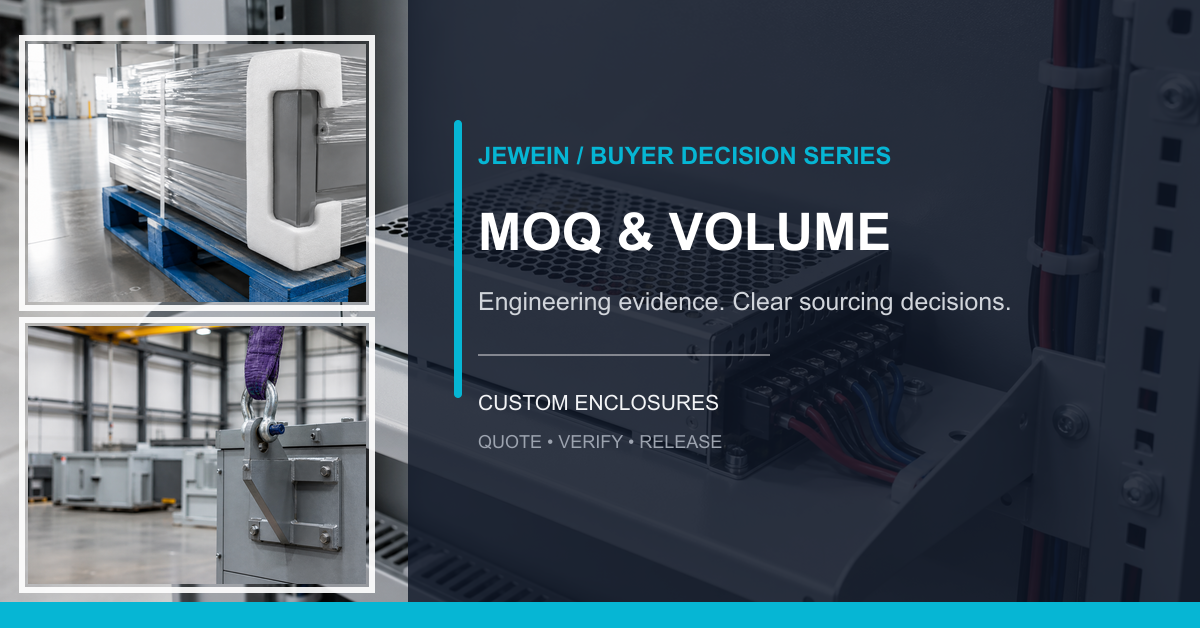
There is no universal minimum order for a custom cabinet. Custom electrical enclosure MOQ depends on how much work is shared across units: engineering, machine setup, bend tools, welding fixtures, coating color, purchased hardware, inspection and packaging. A buyer should not ask only “What is your MOQ?” The better question is “Which process changes at each quantity band, and what commitment makes that route economical?”
Direct answer: Request separate prices for sample, pilot and repeat production, with tooling and purchased-part minimums shown outside the unit price. Share a realistic mix and forecast range. Then compare total commitment, revision risk and inventory exposure alongside the apparent saving per enclosure.
Find the Minimum Behind the Minimum
A supplier's stated quantity may be driven by a coating batch, custom gasket, special lock, printed label, carton, imported component or the time needed to set up fabrication. Ask which item creates the constraint and whether it can be separated. Sometimes ten enclosures are practical but a purchased component must be bought in a larger pack. Sometimes one enclosure is possible if the buyer accepts a standard color or pays setup independently. Custom electrical enclosure MOQ becomes negotiable only when its drivers are visible.
Do Not Use Prototype Price as a Volume Promise
Prototype work uses flexible routing and absorbs engineering attention. Repeat production may use better nesting, dedicated fixtures, batch coating and scheduled inspection. Ask for both routes and the volume at which the change is justified. The Jewein prototype validation guide helps define what the first units must prove. A supplier should not promise repeat pricing until the drawing, finish, purchased parts and acceptance method are sufficiently stable.
Three order scenarios, three different decisions
| Order stage | Supplier priority | Buyer decision |
|---|---|---|
| Prototype | Fast learning with flexible setup | Which uncertainty must close? |
| Pilot | Repeatability and process proof | Is the revision stable? |
| Repeat lot | Nesting, fixtures and flow | Is demand credible? |
| Mixed variants | Changeover and common parts | Can families be grouped? |
| Service spares | Long-term availability | How will small repeats be handled? |
An order-band worksheet that keeps commitments honest
Build rows for sample, pilot, first repeat, mature repeat and service spare. Add columns for firm quantity, forecast range, variant mix, required delivery lot, material purchase, fixture gate, finish batch, inspection level and revision freeze. Ask the supplier to show which assumption changes price at each row. Then add buyer inventory months and the latest date a design change can be absorbed. The worksheet reveals whether a low unit price requires buying far ahead of demand or whether a moderate setup charge preserves flexibility. Review the plan at each release rather than allowing the largest forecast number to become an accidental purchase commitment.
Include a column for obsolete-stock responsibility and another for the smallest economical replenishment after the main program ends. Those two answers expose long-term commitment that an attractive launch price may omit.
Test the MOQ against four demand patterns
A launch order has high revision risk and uncertain mix. Custom electrical enclosure MOQ should be evaluated against staged release, with common material purchased first and configuration-specific work delayed where practical. Ask which costs recur if the pilot changes. The buyer may prefer a higher early unit price to preserve flexibility, then authorize fixtures or batch purchasing after fit and demand are clearer. This is a deliberate option value, not purchasing indecision.
A stable repeat order can support nesting, scheduled coating and kanban-style replenishment, but only when drawings and forecast behavior are genuinely stable. Custom electrical enclosure MOQ should then be linked to economic batch, delivery lot and inventory ownership as three separate numbers. A factory may build a larger batch while delivering smaller releases. Record storage conditions, identification, payment and revision responsibility before treating that arrangement as free inventory.
A mixed-variant program needs a commonality map. Custom electrical enclosure MOQ may be calculated by shared cabinet, by color, by hardware family or by finished part number. Ask the supplier to show the point at which variants diverge. Postponing doors, gland plates or labels can reduce finished-goods exposure, but it may add handling and final inspection. Compare the whole process rather than assuming late configuration is automatically cheaper.
A spare-parts program reverses the volume problem: demand is small but availability must last. Custom electrical enclosure MOQ should include an end-of-production strategy for drawings, tools, standard hardware, alternate materials and minimum service lots. Decide whether a universal replacement panel is acceptable or whether exact cosmetic match is required. The answer changes how long powder, labels and fixtures must be retained.
A seasonal or project-based order needs timing as well as quantity. Custom electrical enclosure MOQ may be met across a blanket order, but material escalation, storage and engineering changes need rules. Ask for cancellation points and the moment parts become customer-specific. Buyers should compare firm commitment with forecast flexibility in plain numbers, while suppliers should identify which purchasing actions depend on each commitment level.
For custom electrical enclosure MOQ, the IEC 62208:2023 publication page supplies primary-source context for volume bands tied to manufacturing route and buyer commitment. This source does not certify custom electrical enclosure MOQ, set project acceptance by itself, or replace review by the responsible specialists.
Group Variants by What the Factory Shares
Ten sizes with different doors, hardware and colors are not the same as ten units of one design. Build a family matrix showing common sheet, hardware, finish, tooling, packaging and inspection. Ask which variants can share cutting nests or coating lots and which require a clean changeover. A common cabinet with late-stage configurable plates may reduce commitment, but only if the interfaces are controlled. The price comparison should show the cost and risk of postponing configuration.
Put Tooling Outside the Unit Price
A forming tool, weld fixture, inspection gauge, mask or foam insert may make a lower recurring price possible. Separate its cost, ownership, storage, maintenance and revision limit. Otherwise a nominally low MOQ can hide a large first-order commitment, or a higher unit price can unfairly appear uncompetitive because it includes reusable work. Tie tooling to the part revision and state whether another supplier could use it. The Jewein captive fastener guide illustrates how a small hardware choice may also change installation tooling.
Price Inventory Risk Alongside Unit Cost
A larger lot can reduce setup per unit while increasing cash, storage, damage, obsolescence and engineering-change exposure. Compare landed cost at the likely consumption rate, not only the factory unit price. Consider whether uncoated blanks, universal gland plates or common hardware can be held before final configuration. Do not ask the supplier to hold undefined inventory without an ownership and forecast rule. The commercial agreement should say when material becomes buyer-specific and what happens after a revision.
Ask for a Ramp Plan, Not a Single Number
A useful proposal shows sample quantity, pilot quantity, repeat batch, lead time at each stage, tooling gate, forecast window and change-freeze date. It also explains service-spare orders after volume production ends. Send Jewein the expected family mix through the contact page so the quote can distinguish committed quantity from planning volume. The best MOQ is the smallest honest commitment that supports the required process and evidence, not the smallest number printed in an email.
MOQ questions importers and project buyers raise
Can Jewein make one custom enclosure?
Feasibility depends on design, finish, hardware and evidence needs; a one-off may carry separate engineering and setup charges.
Why does coating affect MOQ?
A nonstandard color or texture can require line setup, powder handling, cleaning, coupons and a minimum practical batch.
Does MOQ include all enclosure variants?
Only when the supplier confirms which processes and purchased items the variants genuinely share.
Can tooling reduce the minimum order?
It may lower recurring labor or improve repeatability, but the buyer should compare the tooling commitment and revision risk.
What is a pilot order?
It is a limited production-intent batch used to confirm repeatability, documentation and handling before broader release.
How should forecasts be shared?
Use realistic ranges, timing and variant mix, clearly separating planning information from firm purchase commitments.
Can standard hardware lower MOQ?
Often it reduces purchased-part constraints and replacement risk, provided the standard part meets the released function.
Why are small repeat orders difficult?
Setup, material purchasing, color batching and document work recur even when only a few replacement units are needed.
Should buyers accept a large MOQ for a lower price?
Only after comparing landed inventory cost, consumption, storage, damage and the chance of a design change.
What should an MOQ quotation show?
It should show volume bands, setup, tooling, purchased-part minimums, lead time, variant assumptions and spare-order rules.
The Jewein decision boundary
Custom electrical enclosure MOQ is a process decision disguised as a quantity. Buyers gain leverage by exposing setup, tooling, coating, hardware and variant drivers, then choosing a staged commitment that matches design maturity. Jewein can price realistic bands once the family mix and evidence package are visible.