


Packaging should be designed around the journey, not around the moment a clean cabinet leaves final inspection. A custom enclosure packaging specification maps forklift entries, truck vibration, rain exposure, warehouse stacking, lifting, unpacking and site movement. It also defines what must remain aligned, dry, identifiable and accessible. When those events are visible, the supplier can choose restraints and protection that suit the actual enclosure instead of wrapping it until damage is hidden.
Direct answer: Provide the packed mass and center of gravity, handling route, protected surfaces, door and panel restraints, moisture strategy, lifting points, loose-parts plan, destination limits and required packing evidence. Validate a representative pack against the hazards agreed by the project team.
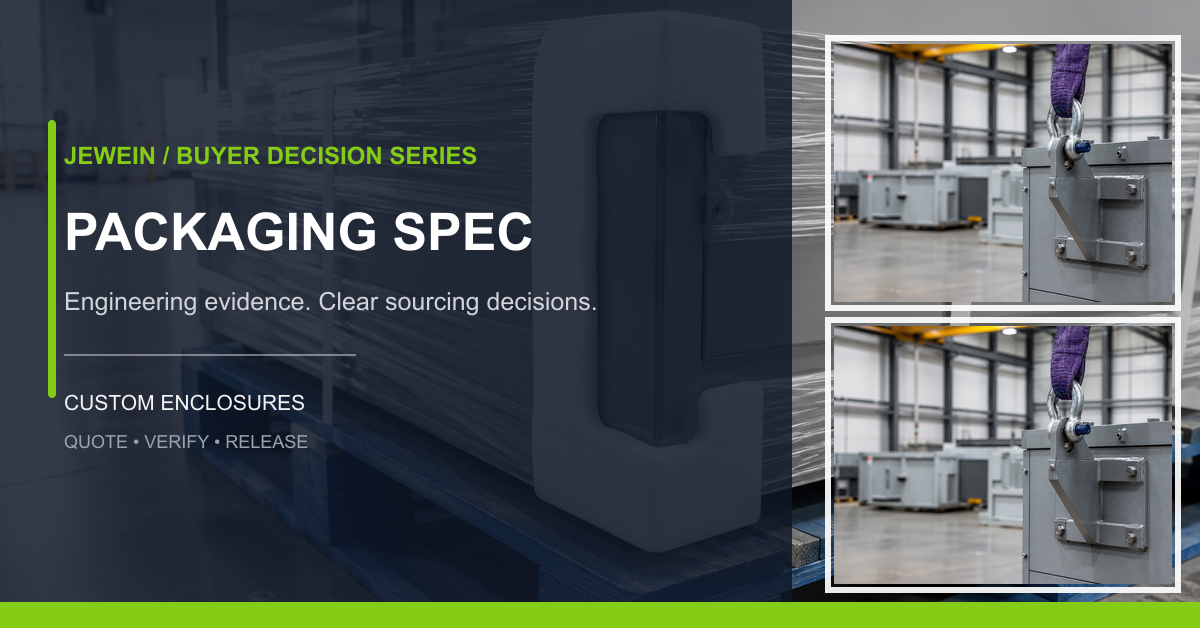
The delivery journey as a design input
| Journey event | Packaging job | Release evidence |
|---|---|---|
| Factory move | Stable base and fork access | Lift trial |
| Road transport | Restrain cabinet and doors | Witness marks and photos |
| Storage | Control moisture and stacking | Storage label |
| Site lift | Expose rated handling points | Unpacking instruction |
| Final unpack | Avoid tool and edge damage | Condition checklist |
For custom enclosure packaging specification, the ISTA guidelines for selecting test procedures supplies primary-source context for following the enclosure through each handling event. This source does not certify custom enclosure packaging specification, set project acceptance by itself, or replace review by the responsible specialists.
Draw the Packed Center of Gravity
Show enclosure mass, major installed components, center-of-gravity estimate, base contact and permitted orientations. An apparently centered empty cabinet may become top-heavy when equipment or a cooling unit is installed. Mark fork tine spacing, entry direction and any side that must not be lifted. Custom enclosure packaging specification decisions should follow the shipped configuration, not a generic cabinet outline. If mass changes between variants, give each pack its own identity and handling note.
Restrain Motion Without Loading the Door
The crate or pallet should carry transport forces through the frame, plinth or intended mounting points. Avoid straps that pull on a door skin, window, handle or gasket. Lock removable panels and support heavy internal equipment according to the approved configuration. Use visible witness marks where a restraint could loosen. The Jewein transport skid guide helps define the base interface, while the pack still needs its own blocking, bracing and removal sequence.
Protect Finish at the Contact Point
Foam, film, corner pieces and straps can polish, stain or imprint powder coating when pressure, dust, heat and time combine. Name approved contact materials and keep abrasive packing away from finished edges. Provide clearance around protruding locks, hinges, louvers and gland plates. The Jewein corner protector guide offers a focused check for vulnerable bends. Trial the protection after realistic storage time rather than judging it immediately after wrapping.
Treat Moisture as a Time-and-Climate Problem
Map rain during loading, container humidity, temperature cycling, warehouse exposure and the condition at unpacking. Select barrier materials, ventilation, desiccant or corrosion protection only after the route and storage period are known. Do not seal a wet enclosure inside an impermeable bag. State whether doors, filters or cable openings must remain closed, and add humidity or condition indicators only when someone is assigned to read and act on them.
Make Loose Parts Impossible to Lose
List keys, handles, feet, brackets, fasteners, documents, touch-up material and electrical accessories. Give each kit a part number, quantity and location that can be found without dismantling the enclosure. Prevent hardware bags from scratching painted surfaces or disappearing inside wiring ducts. Put installation-critical items near the unpacking instruction, and record their count before closing the crate. A packing photograph should show both the kit and its restraint.
Validate the Pack and the Unpack
Select test or handling simulations that match the shipment hazard and project consequence; ISTA guidance can help teams choose an appropriate procedure but does not select one automatically. After the trial, inspect alignment, finish, seals, hardware, restraints and internal supports. Then have someone unfamiliar with the pack follow the unpacking sequence using normal site tools. Send Jewein the route and condition requirements through the contact page so packaging is quoted as a controlled deliverable.
Write the unpacking scene before designing the crate
Describe the receiving space, available forklift or crane, doorway, floor, weather and team size. A custom enclosure packaging specification should not require a tool, clearance or lifting device that the destination does not have. Mark which side faces the aisle and where documents can be reached before the cabinet is moved. If the site must store the package unopened, give inspection and storage instructions visible from outside.
Sequence fastener removal so the pack remains stable. A custom enclosure packaging specification should identify braces that carry load and decorative panels that do not. Number or color-code removable members without relying on text alone, and prevent an operator from releasing the base restraint while the enclosure is still top-heavy. Provide a safe location for removed nails, bolts or steel straps so they do not damage the finish or become trip hazards.
Protect the cabinet during the short move after unpacking. A custom enclosure packaging specification may need temporary feet, fork pockets, lifting brackets or reusable door restraints that remain until final position. State when each protection may be removed and where it is stored or discarded. The last meter from crate to plinth can expose the cabinet to more uncontrolled contact than the long vehicle journey.
Make condition reporting simple enough to happen. A custom enclosure packaging specification should include package identity, seal condition, moisture indicator where used, impact evidence, photographs before opening, enclosure inspection points and a deadline for reporting. Distinguish transport damage from manufacturing nonconformance without forcing the receiver to decide root cause. Preserve packing materials until the responsible parties agree on evidence needs.
Decide whether the crate, skid or protective hardware will be returned, reused or discarded. A custom enclosure packaging specification should show ownership, removal method, material identification and destination obligations. Reusable packaging can be economical only when return freight, inspection and repair are controlled. Do not label packaging sustainable without evidence about the actual route and reuse behavior.
A route review for an outdoor control cabinet
Consider a tall cabinet collected by truck, held for several days at a coastal warehouse, transferred into a container and unpacked on an unfinished site. The package needs a stable base and lifting access, but it also needs a moisture plan that accounts for temperature change and an instruction that survives rain. Door restraints must be removable without standing in the fall path. Loose plinth hardware should be counted and accessible before the cabinet is lifted. The receiver should photograph outer condition, indicators and restraint state before opening. None of these choices can be inferred from the cabinet drawing alone; the route, storage duration and site equipment complete the design input.
Now test a disruption: the crate arrives one week early and must remain outside under a temporary shelter. The team should know whether the original barrier and storage label cover that exposure, how often condition must be checked, and who can authorize opening. If the route changes from container to air freight, review restraint, handling and package dimensions instead of assuming stronger wrapping is enough. Preserve the actual packed configuration and any test evidence with the shipment record.
Packaging questions to settle before shipment
Is stretch film enough for an enclosure?
It may control dust or light contact, but it does not automatically provide structural restraint, impact or moisture protection.
Should the cabinet ship upright?
Use the orientation approved for its structure, installed contents, center of gravity and handling route, then label it clearly.
Can straps pass over the door?
Avoid loading doors, windows, handles and seals unless the packaging design specifically supports and verifies that path.
How should forklift access be specified?
Show entry sides, tine spacing, clearance, base strength, packed center of gravity and prohibited lift points.
Are desiccants always required?
No. Their use depends on moisture barrier, package volume, starting condition, route, climate, storage time and monitoring plan.
What belongs in the loose-parts kit?
Include every removed or separately installed item with part identity, quantity, protection, location and installation reference.
Should packing be photographed?
Yes. Useful images show enclosure identity, restraints, protected features, loose parts, closure and final package labels.
How is packaging validated?
Agree on handling or test conditions that represent the route, then inspect the enclosure and unpacking process afterward.
Who owns disposal requirements?
The buyer should state destination rules or sustainability requirements so materials and labels can be selected before packing.
What should appear on the package label?
Show project and part identity, quantity, mass, orientation, handling limits, destination and any storage or unpacking warning.
The Jewein decision boundary
A custom enclosure packaging specification is successful when the cabinet reaches the site aligned, protected, traceable and easy to unpack without improvisation. Mapping the actual journey makes restraint, moisture control and evidence proportionate. Jewein can review that journey once the shipped configuration and destination limits are known.