


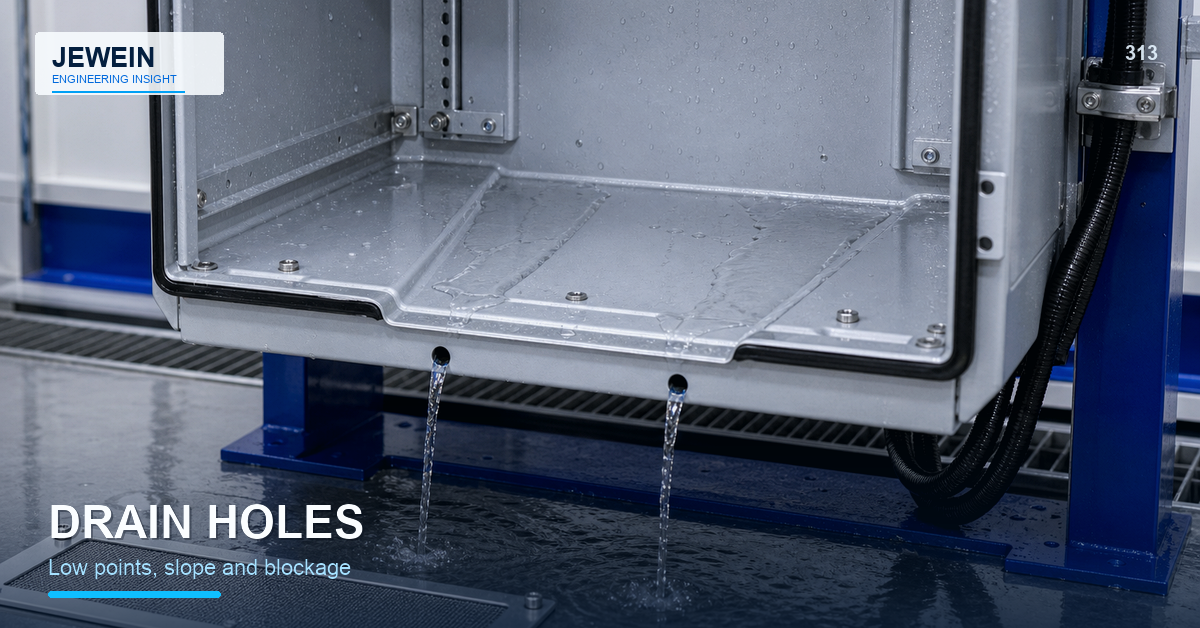
Drainage is not the same as drilling a low hole. A channel has to collect water from the intended surface, preserve the seal boundary, avoid carrying dirt into the cabinet and remain cleanable after coating and transport. It also needs a destination that will not wet a cable entry or a mounting foot. The useful buying question is where water starts, how it moves, and what evidence proves the route works in the installed orientation.
Working answer: Map the water path first, then set the channel section, slope, outlet, finish treatment and cleaning access around that map. Test both a wet surface and a dirty surface so the drain is judged as a service feature, not a shiny sample detail.
| Check | Confirm | Risk if missed |
|---|---|---|
| Source | Condensation, washdown or rain | Wrong collection area |
| Slope | Continuous fall to outlet | Standing water |
| Outlet | Safe discharge location | Re-entry or staining |
| Finish | Burr and coating control | Blocked route |
| Cleaning | Brush and access path | Debris build-up |
The IEC 62208 publication provides enclosure-level context, but it does not qualify this custom managed water route interface or replace component instructions and project-specific verification.
Map Water Before Metal
Draw the roof, door return, gasket land, cable plate and mounting surface in the orientation used by the customer. Identify whether the channel handles condensation, a washdown stream, rain or a spill during service. These sources may need different limits. In sheet metal enclosure drainage channel design, the first datum is the collection edge, not the drain hole. Mark the route and its forbidden zones so an outlet cannot accidentally cross a seal, label or electrical entry.
Choose a Cleanable Section
A shallow fold is easy to form but can hold a film of dirt; a deeper channel carries more water but consumes interior height and may trap coating powder. Compare a formed trough, a separate rail and a replaceable insert. Show the inside corner radius, minimum width, burr condition and access for a brush or cloth. If a channel ends in a small outlet, define how the outlet is protected from paint build and how it is checked after finishing.
Give the Slope a Datum
State the fall relative to a frame edge or mounting plane and include tolerance. Outdoor cabinets may be leveled differently from a laboratory enclosure, so the usable slope range matters. Check a nominally level installation and the most unfavorable permitted tilt. Keep the channel from reversing water toward a gasket. The related Jewein rain protection article at this link can inform the surrounding roof design; the channel needs a separate measured acceptance.
Put the Outlet Somewhere Safe
An outlet should discharge away from cable glands, hinges, lifting points and surfaces that return water to the cabinet. Add a drip edge or short spout if the outlet face can wet the frame. Consider whether a technician can see the first drop and clear a blockage without removing a large panel. Photograph the discharge direction with the enclosure in its installed attitude. A route that works on a tilted bench may fail when the cabinet is leveled on site.
Check Finish and Debris
Powder, sealant and shipping film can reduce the clear section of a small channel. Inspect after the real finish, then introduce the debris likely to arrive from cutting, gasket trimming or field work. Record the cleaning method and the maximum residue allowed. Do not use an unqualified water test to imply an ingress rating; the responsible specialist owns that decision. The buyer record should simply show that the intended drainage path stayed open and repeatable.
Run a Wet-and-Dirty Trial
Wet the collection surface at a controlled rate, observe the route, pause, then repeat with a representative amount of dust or gasket debris. Check the outlet, adjacent seals, label faces and interior surfaces. Run the test with doors and removable panels in their normal positions. Record start time, orientation, flow observation, photographs and any rework. This evidence is more useful than a single clean stream because it exposes the ordinary blockage a customer will meet.
Specify the Cleaning Handoff
An RFQ should include channel section, datum, slope tolerance, outlet location, finish, burr limit, cleaning tool, test orientation, packaging and replacement rule. Ask suppliers to mark the route on their fabrication drawing and identify any weld or seal that changes the path. Link the drain feature to the enclosure revision. Contact Jewein at https://www.jewein.com/contact-us when the water map and acceptance record need a DFM check.
Managed water route Approval Notes
At the design review, translate managed water route into a physical setup that a supplier and an inspector can both understand. Use the source requirement as the first datum, then mark the slope interface, the outlet clearance and the finish limit on the same view. The sheet metal enclosure drainage channel design record should state what is fixed, what may adjust and what condition forces another review.
For the first article, assemble the drainage channel, roof, outlet, gasket, debris and finish with production-like material, finish, mating parts and normal tools. Check the released managed water route state before adding a difficult tolerance or a substitute component. Measure the outlet feature most likely to drift in the managed water route assembly, photograph the operator side and record the part revisions. A clean sample is useful only when the sheet metal enclosure drainage channel design acceptance notes explain how the same result will be repeated on the line.
Procurement should ask for assumptions in a marked-up drawing instead of accepting a broad statement that the drainage channel, roof, outlet, gasket, debris and finish will fit. Request the source load or duty boundary, installation order, inspection method, spare identity and change triggers. The related Jewein planning note can frame the neighboring interface, while the topic guide keeps the sheet metal enclosure drainage channel design decision tied to the correct enclosure revision.
The managed water route service walkthrough should include the least convenient approved variant, the actual access direction and the tool that a technician will carry. Observe where a hand, cable, label or fastener changes the managed water route sequence, and record any step that depends on a second person or specialist approval. Repeat the check after removal and reinstallation so the sheet metal enclosure drainage channel design design is judged as a working service feature rather than a one-time assembly success.
When a device, panel, coating, hardware family or environment changes, compare the new condition with the released managed water route boundary. Review the source datum, slope response, outlet clearance and finish behavior before deciding that an old sample still applies. This change-control habit keeps the sheet metal enclosure drainage channel design file useful across variants without pretending that similar geometry is automatically equivalent.
At handover for the drainage channel, roof, outlet, gasket, debris and finish, keep the drawing, variant matrix, work instruction, inspection aid, sample photographs, test or screening record and spare rule together. Note the exact orientation, torque or setting, cleaning limit and permitted rework for the drainage channel, roof, outlet, gasket, debris and finish. The final sheet metal enclosure drainage channel design package should make a field decision traceable to Jewein's released interface while leaving final electrical, thermal, mechanical and compliance judgments with the qualified project owners.
Questions Buyers Ask About managed water route
What should be frozen before a supplier quotes? — managed water route
For managed water route, freeze the functional geometry, controlling datum, duty, service action and replacement boundary before pricing. The drainage channel, roof, outlet, gasket, debris and finish boundary should be visible on the drawing.
When is a similar part an acceptable substitute? — managed water route
A drainage channel, roof, outlet, gasket, debris and finish substitute is acceptable only after accept it only when dimensions, materials, loads, clearances, service behavior and evidence match the released record. Keep the approved managed water route state as the comparison point.
What belongs in the first production sample? — managed water route
The managed water route sample should use production hardware, finish and tools, then follow the complete service sequence.
How can a hidden failure be exposed? — managed water route
Expose a hidden managed water route defect with a datum, functional check, witness mark and photograph tied to the failure mode.
What usually creates field rework? — managed water route
Field trouble with the drainage channel, roof, outlet, gasket, debris and finish often follows late changes, coating effects, poor access or an untested service action.
What should the RFQ request? — managed water route
An RFQ for managed water route needs the released CAD, material, duty, environment, access, sample plan, inspection and spare rule.
When should the pilot be repeated? — managed water route
Repeat the managed water route pilot when the panel, hardware, component family, coating, route, environment or service routine changes.
How should the spare be named? — managed water route
Identify a drainage channel, roof, outlet, gasket, debris and finish spare by enclosure revision, functional location, mating parts, installation method and replacement limit.
What should handover records contain? — managed water route
Handover for managed water route should show the drawing, variant matrix, work instruction, inspection method, images, result and change triggers.
Who owns final safety decisions? — managed water route
Final safety ownership for drainage channel, roof, outlet, gasket, debris and finish stays with qualified specialists; this guide keeps the engineering and purchasing boundary clear.
Jewein Release Note: managed water route
A sound sheet metal enclosure drainage channel design package lets a buyer compare suppliers around the source datum, the slope response and the managed water route service boundary. It records the outlet evidence and the change trigger that would reopen the review. Jewein can review this drainage channel, roof, outlet, gasket, debris and finish interface through the contact team, while qualified specialists retain final electrical, thermal, mechanical and compliance decisions for the installed system.