


A nesting program can report excellent material utilization while production struggles with tipped parts, overheated edges, mixed grain direction, scratched cosmetic faces, and a skeleton that is difficult to unload. Material yield is only one part of the cost.
Sheet metal nesting optimization arranges parts on sheet stock to balance material use with cut stability, grain and finish direction, heat, edge quality, part identification, unloading, remnant control, and repeat-order consistency.
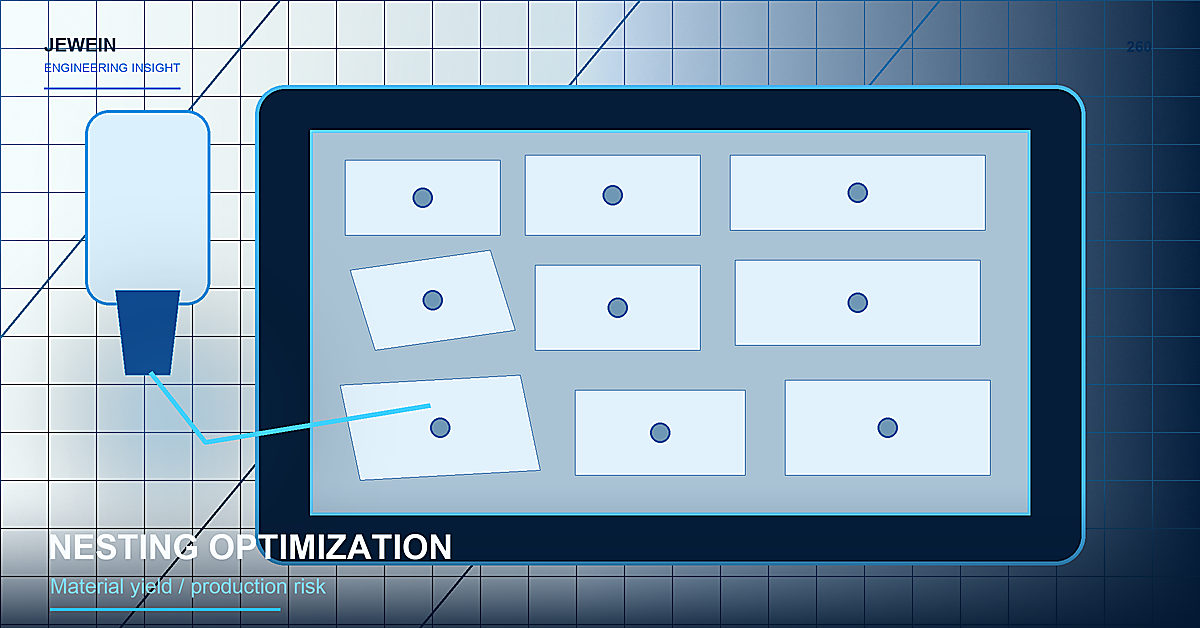
Use a Yield-Versus-Risk Model
Evaluate a nest across four outcomes:
- material consumed per accepted part;
- machine time and interruption risk;
- downstream quality and handling;
- repeatability across the order and future lots.
A slightly lower geometric yield may produce a lower accepted-part cost when it prevents tip-up, scratches, rework, or sorting errors.
Lock Only the Directions the Product Needs
Rotation can improve nesting density, but some parts have forming or cosmetic direction requirements. Define why orientation is controlled.
- Rolling direction may affect a difficult bend.
- Brushed finish direction may need to align across an assembly.
- Film direction or surface side may affect appearance and handling.
- Formed features may need a specific relationship to material or tooling.
The sheet metal grain direction guide explains how functional and cosmetic direction can compete with material yield.
If rotation is optional, say so. An unnecessary arrow can force scrap into every future order.
Consider Heat and Cut Sequence
Closely packed parts and long shared cut paths can concentrate heat. Thin parts may move, edges may change, or later cuts may lose stability after the surrounding skeleton weakens.
Review:
- material and thickness;
- laser, plasma, punch, or other process;
- spacing and common-line strategy;
- cut order and cooling opportunities;
- small-part tip-up;
- micro-joints or retention features;
- effect on edge quality and deburring;
- unloading after the sheet loses stiffness.
The best strategy depends on the machine and part. Avoid universal spacing or heat rules without supplier evidence.
Shared Edges Need Product Approval
Common-line cutting can reduce material and machine travel, but the edge condition, corner behavior, burr, heat, and dimensional relationship may differ from separately cut profiles.
Use shared edges only where the resulting quality supports the drawing and downstream process. Cosmetic edges, tight interfaces, small tabs, or features near bends may require more separation.
Small Parts Need a Retention Plan
A dense nest of small brackets can stop the machine when parts tip, collide with the head, or fall through the support. Micro-joints, tabs, film, or another retention method may help, but they add removal and edge-finishing work.
Include the true labor:
- breaking parts from the sheet;
- removing tabs;
- deburring local witnesses;
- sorting similar parts;
- protecting surfaces during collection;
- counting and packaging.
Material saved at the machine can reappear as downstream handling cost.
Protect Cosmetic Faces During Unloading
Parts can scratch when they slide across the skeleton, stack with debris, or are dropped into a common bin. The nest should support an unloading method appropriate to the finish and part geometry.
Identify controlled faces, protective film, lift points, separators, stack orientation, and maximum pile condition. Wide panels may need additional skeleton support to preserve flatness.
Treat Remnants as Controlled Material
Remnants can reduce cost only when the business can identify and use them. Control:
- material grade and specification;
- thickness;
- finish and direction;
- heat or lot identity when required;
- usable dimensions;
- surface condition;
- storage location;
- age and corrosion;
- system inventory and reservation.
An unidentified remnant is not a saving. It is a mix-up risk and storage cost.
Compare Sheet Size and Purchase Format
A larger sheet may improve yield but require different handling, machine capacity, storage, or freight. A smaller standard sheet may reduce unused inventory for a low-volume order.
Ask whether the quote assumes a full sheet, partial sheet, customer-owned stock, coil-fed material, or shared demand with other work. The sheet metal fabrication cost guide helps place material utilization beside setup, processing, finish, inspection, and packaging.
Include Traceability and Sorting
Similar left-hand, right-hand, or revision parts can be nested together and then mixed during unloading. Use part marking, nest maps, separated zones, labeled containers, or controlled counts where the risk justifies it.
High utilization does not compensate for shipping the wrong revision or losing material traceability.
Ask for the Accepted-Part Cost Story
When comparing quotes, ask:
- What sheet size and material utilization were assumed?
- Which orientation restrictions were applied?
- Are remnants credited or reserved?
- Does the route use common-line cutting or micro-joints?
- What deburring and unloading labor is included?
- How are cosmetic faces protected?
- How are mixed parts and revisions separated?
- What changes when quantity increases?
These questions make the nesting assumption visible without demanding the supplier's proprietary program file.
Release Nesting Constraints, Not One Frozen Layout
The buyer usually needs to control material, direction, surface, edge, traceability, and product quality rather than one exact nest. The supplier can then improve the layout within those constraints.
For recurring sheet metal nesting optimization, retain the approved constraints, sheet assumptions, direction rules, cut-quality needs, retention method, unloading plan, remnant policy, and change triggers.
Jewein describes its engineering-driven support as analyzing applications and drawings, improving manufacturability, identifying production risk, integrating supply needs, and preparing scalable solutions. The Jewein company overview provides that company context. Final nesting and cutting controls remain machine-, material-, and supplier-specific.
Buyers can contact Jewein with the part mix, material, thickness, direction limits, finish, quantities, edge requirements, and current scrap or handling issue for a practical sheet metal nesting optimization review.
Frequently Asked Questions
What is sheet metal nesting optimization?
It is the arrangement of flat parts on sheet stock to improve material use while respecting cutting, quality, handling, and product constraints.
Why is the highest material yield not always the best nest?
A dense nest can increase heat interaction, part tip-up, difficult unloading, grain conflicts, scratches, or traceability problems.
How does grain direction affect nesting?
Locked forming or cosmetic direction can limit rotation and reduce yield, so the reason for the direction requirement should be defined.
Can remnants reduce sheet metal cost?
They can when size, material identity, condition, storage, and traceability support future use without creating mix-up or handling risk.
What should buyers ask about nesting cost?
Ask how material utilization, sheet size, direction limits, part spacing, skeleton handling, remnants, and repeat-order quantity were considered in the quote.