


A visible water test can show that an enclosure leaks but may not reveal where the path begins. Pressure decay can quantify a change, yet temperature drift, flexible panels, temporary plugs, and fixture volume can look like leakage. A useful leak test separates the measurement method from the physical path.
Plan sheet metal enclosure leak testing around the functional boundary, test medium, pressure, enclosed volume, temporary seals, stabilization, allowable leakage, localization, equipment capability, records, and reaction plan. The method should not damage the enclosure or create an unrealistic seal load.

Define What Counts as the Test Boundary
Identify doors, seams, vents, drains, cable entries, windows, plugs, fasteners, and temporary interfaces. Decide whether intentional breathing paths are included, isolated, or measured separately.
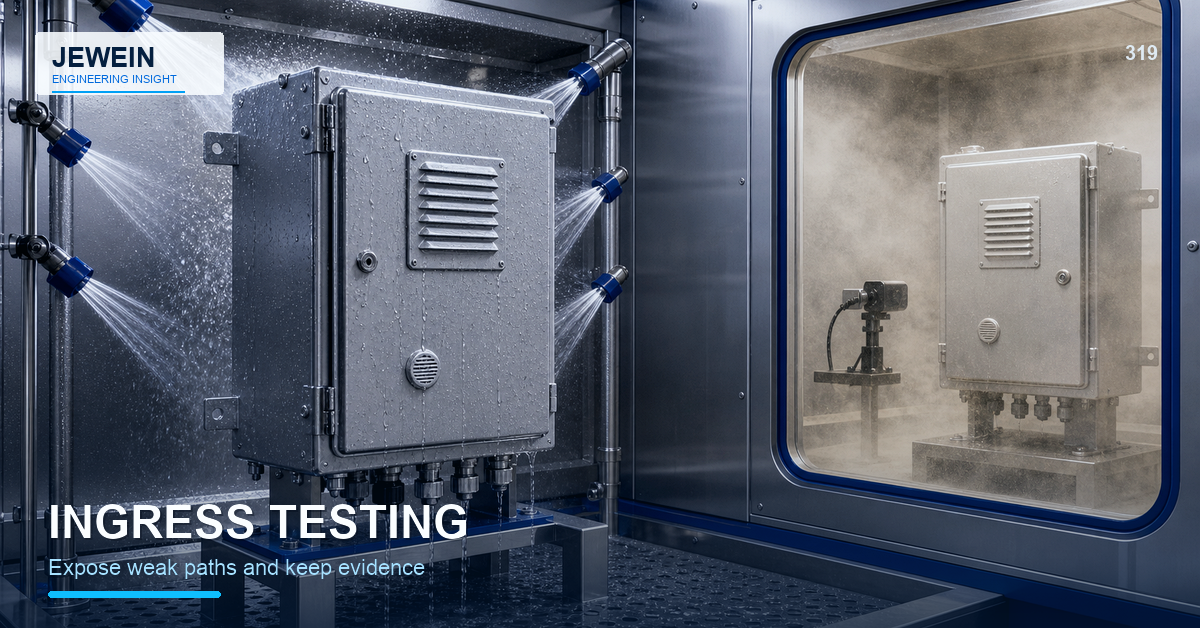
The sheet metal enclosure ingress testing guide explains how production configuration, mounting, exposure, drainage, and inspection timing shape environmental evidence.
Select a Method for the Decision
Options may include pressure decay, vacuum decay, flow measurement, bubble solution, tracer gas, acoustic tools, water tracing, or segmented isolation. Each has different sensitivity, cycle time, cost, safety, and localization ability.
Choose the method for the allowable leakage and path size that matter to the product. Do not choose only because equipment is already available.
| Method factor | Possible false signal | Control direction |
|---|---|---|
| Temperature change | Pressure drifts without a leak | Stabilize and record temperature |
| Flexible walls | Volume changes under pressure | Limit pressure and support consistently |
| Fixture volume | System response becomes slow | Define and minimize test volume |
| Temporary plug | Plug leaks or over-seals | Verify fixture interface separately |
| Seal relaxation | Reading changes with time | Control dwell and sequence |
Use a Safe and Representative Pressure
Pressure should relate to product function and method sensitivity without bowing panels, over-compressing gaskets, opening drains, or loading doors beyond service conditions.
For sheet metal enclosure leak testing, observe panel movement during development. A stiff fixture can restrain a wall and create a result that the free product cannot repeat.
Stabilize Temperature and Volume
Gas pressure responds to temperature. Handling, compressed air, warm components, sunlight, and test-room changes can create drift.
Use consistent fill, dwell, measurement time, and thermal condition. Record internal or fixture temperature where the method needs it. A longer test is not automatically better if thermal drift dominates.
Verify the Fixture Before Testing Parts
Test caps, hoses, valves, seals, and connectors can leak. Run fixture checks, known-leak verification, and maintenance at defined intervals.
Keep fixture seals away from product seals when possible so the source can be distinguished. Record calibration and software revision.
Localize After Quantifying
A total leak result supports pass or fail but does not identify the repair. Use bubble solution, tracer gas, segmented masking, local vacuum, or another suitable method to find the path.
Preserve the failed condition before tightening hardware. The sheet metal enclosure gasket guide helps investigate compression, corners, flange geometry, door stiffness, coating, drainage, and service damage.
Separate Weld, Door, and Hardware Paths
Seam weld porosity, door gasket gaps, warped covers, loose fasteners, cable glands, vents, and sealant discontinuities can produce similar total leakage.
The seam welding enclosure guide connects joint path, fit-up, heat input, distortion, finishing, leak requirements, inspection, and service.
Define the Acceptance Rule
State allowable leakage, units, pressure, direction, test time, stabilization, temperature condition, retest rule, and disposition. Avoid a bare number detached from the method.
Include measurement uncertainty and known fixture contribution when decisions are close to the limit. Final quantitative method design requires qualified test and metrology specialists.
Connect Development and Production Tests
A sensitive development method can find small paths, while production may need a faster screening test. Correlate the two and use known defects or calibrated leaks where appropriate.
Define reaction to a failed production test: containment, localization, repair limits, retest, lot review, and escalation.
Verify the Method With Known Leaks
Use calibrated or otherwise controlled leak artifacts that span the decision range. Confirm detection after fixture maintenance and at planned intervals. A zero reading from a blocked line or failed sensor can look like an excellent enclosure, so positive method checks need a defined place in the production sequence.
Review Changes and Service
New gaskets, torque, coating, weld process, gland, vent, sealant, fixture, software, or test location can change results. Control substitutions and retest after significant service.
The enclosure pressure equalization vent guide helps determine whether an intentional breathing path should be isolated or included in the boundary.
Jewein outlines fabricated enclosure review and supplier coordination in its company overview. Final pressure safety, leak limit, test medium, and compliance decisions require qualified specialists.
For a focused sheet metal enclosure leak testing review, contact Jewein with enclosure volume, boundary definition, functional exposure, allowable leakage, test pressure, current fixture, failed data, and suspected path.
Frequently Asked Questions
How is leak testing different from ingress testing?
Leak testing measures or locates gas or liquid paths under a defined method, while ingress testing exposes the enclosure to specified external conditions.
What test pressure should be used?
Use a pressure related to product function and method capability that does not deform the enclosure, overload seals, or create an unrealistic failure.
Why does temperature affect pressure-decay testing?
Temperature changes the gas pressure and enclosure volume, which can look like leakage unless stabilization and compensation are controlled.
How can a leak path be located after a failed test?
Methods may include local bubble solution, tracer gas, segmented sealing, acoustic tools, or controlled water evidence, selected for the product and risk.
Can leak testing be used in production?
Yes when cycle time, fixtures, method capability, temporary seals, limits, calibration, maintenance, and reaction rules support repeatable decisions.