


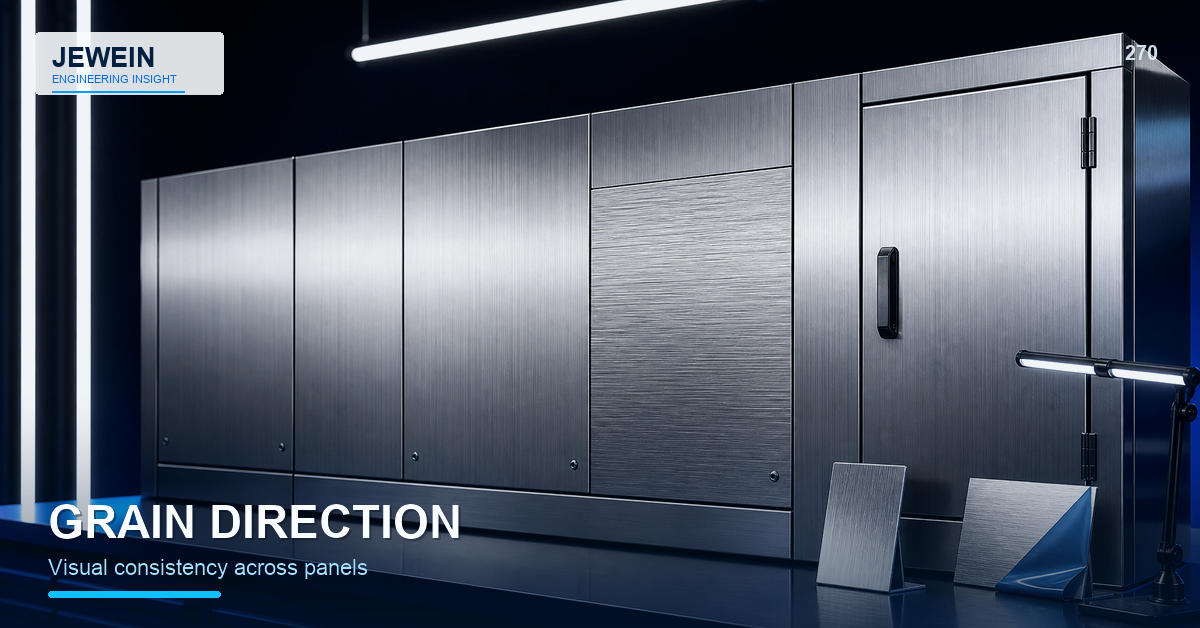
Two brushed stainless panels can use the same alloy and finish designation yet look different when one is rotated. Directional surface lines reflect light along a visual flow, so inconsistent nesting, bending, replacement, or assembly orientation becomes obvious across adjacent parts.
Control brushed stainless steel grain direction from drawing through shipment. Define an orientation for every visible part, preserve it during nesting and forming, approve appearance under agreed lighting, and keep replacement panels tied to the same reference.
Build a Visual-Flow Specification
Start with the assembled product, not individual flat blanks. Mark how the grain should travel across:
- front panels;
- doors and access covers;
- side panels;
- trims and bezels;
- removable service parts;
- replacement components.
The flow may be vertical, horizontal, or intentionally different by zone. What matters is that the drawing and BOM identify the intended relationship.
Translate Assembly Flow Into Part Orientation
A panel may rotate through cutting, bending, and assembly. Add a clear grain arrow to the flat or formed drawing and connect it to a named edge or datum. Avoid notes that depend on the current drawing-sheet orientation.
For bent parts, show how the direction appears on each visible face after forming. A vertical flat-pattern arrow may become horizontal on a return depending on geometry.
The sheet metal grain direction guide covers mechanical bend orientation. Cosmetic grain direction is a separate visual control, although the two can interact.
Decide When Rotation Is Prohibited
Nesting software may rotate parts to improve yield. For directional finish, uncontrolled rotation can create mismatched panels.
| Part condition | Rotation rule | Approval evidence |
|---|---|---|
| Highly visible adjacent panels | Lock to common visual flow | Assembly sample under controlled light |
| Single isolated cover | Defined orientation to product | Drawing arrow and first article |
| Hidden internal bracket | Rotation may be allowed | Cosmetic classification |
| Service replacement panel | Match installed population | Revision and replacement instruction |
| Symmetric-looking part | Still identify orientation | Part mark or packaging cue |
Material savings should be evaluated against the cost of cosmetic rejection and replacement.
Protect the Direction Through Bending
Tool contact can add lines across the original brush, while protective film can wrinkle or trap debris. Bends also change viewing angle and reflectivity. A mark that is minor on a flat sheet may become prominent on a formed face.
Define the cosmetic face, tool-contact restrictions, film route, handling direction, and allowed witness marks. The press brake tool marks guide provides a surface-protection review method.
Approve Under Controlled Lighting
Directional surfaces change with light angle, color, and distance. Establish a repeatable inspection condition:
- light type and approximate direction;
- viewing distance and angle;
- film removed or retained;
- adjacent parts installed or compared on a board;
- allowable shade or line variation;
- fingerprints and cleaning method;
- approved reference sample.
Do not judge one panel under a bench lamp and another after installation in a bright room.
Keep Batches and Replacements Compatible
Brush appearance can vary by mill lot, finishing line, abrasive condition, and supplier. If panels must match, control source material, finish designation, sample approval, and batch segregation.
Replacement panels need the same orientation and a realistic appearance-matching rule. An exact match may be difficult after the installed surface has aged, been cleaned, or changed through service. Define whether a close match, complete panel set, or zone replacement is acceptable.
Separate Grain Direction From Shade Variation
Rotating a panel can create an apparent color change even when the material shade is the same. A true lot or finish mismatch can remain visible even after orientation is corrected. Inspect both factors independently.
For brushed stainless steel grain direction, first align every part to the approved flow, then compare line density, gloss, shade, and surface defects. This sequence prevents teams from chasing a material-lot problem when the immediate cause is rotation, or accepting a shade mismatch because the arrows are correct.
Use Marking and Packaging Without Damaging the Face
Identify orientation on film, a hidden flange, packaging, or a controlled removable label. Do not place permanent marks on visible surfaces unless the design requires them.
Package panels so rotation cannot be confused and faces do not rub. The sheet metal packaging guide provides related controls for finished surfaces.
Create an Appearance Approval Board
For brushed stainless steel grain direction, retain:
- assembled visual-flow diagram;
- part-level grain arrows;
- allowed nesting rotations;
- bend and tooling controls;
- approved film and cleaning method;
- lighting and viewing condition;
- adjacent-panel sample;
- lot and supplier controls;
- replacement-panel rule;
- packaging orientation.
Jewein describes drawing and production-risk review in its company overview. Final cosmetic acceptance should be agreed with representative material and the actual product environment.
For a directional-finish review, contact Jewein with the assembly rendering, part drawings, material finish, visible zones, nesting rules, bend route, lighting expectation, and approved samples.
Frequently Asked Questions
Why does brushed stainless steel have a direction?
The finishing process creates aligned surface lines that reflect light differently when the material or part is rotated.
Should every panel use the same grain direction?
Visible adjacent panels usually need a coordinated visual flow, but the drawing should define the orientation for each part and assembly.
Can parts be rotated during nesting?
Rotation may improve material yield, but it can reverse or cross the visible grain and create an unacceptable assembled appearance.
How do bends affect brushed grain appearance?
Bends change viewing angle and reflection, while tooling, film, handling, and forming direction can add marks that become visible after assembly.
How should grain direction be inspected?
Use controlled lighting, orientation marks, approved samples, adjacent-part comparison, film checks, and packaging controls tied to the drawing revision.