


A formed bracket can meet every finished dimension even when two suppliers use different flat patterns. That is not automatically a mistake. Each shop may be compensating for its material, radius, tooling, bend method, and measured process behavior.
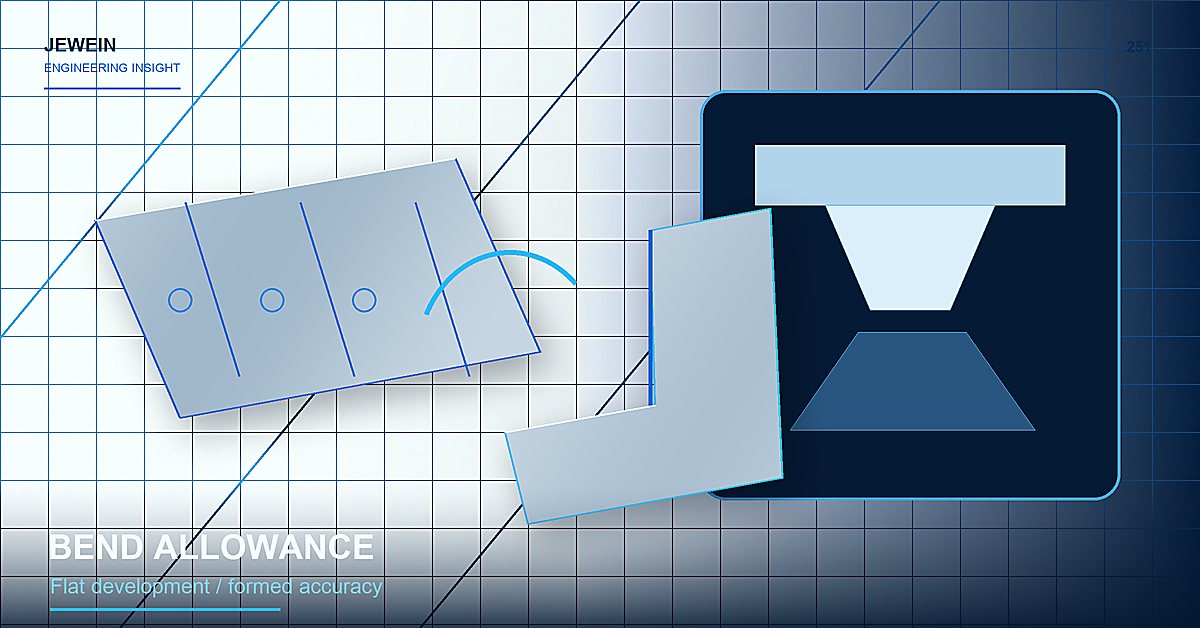
Sheet metal bend allowance is the developed length assigned to the curved region of a bend. Buyers should control the finished part and the approved revision, while suppliers should explain the process evidence behind any flat-pattern change that affects cost, tooling, inspection, or interchangeability.
Quick Answer: Approve the Formed Result and the Development Record
When a flat pattern changes, ask five questions first:
- Is the finished geometry unchanged?
- Which material, thickness, inside radius, and bend method are assumed?
- Was the development based on a model, a shop table, or a representative trial?
- Who controls the production flat pattern and revision?
- What evidence proves the next batch will use the same basis?
The useful decision is not which spreadsheet looks more precise. It is whether the development method produces the required formed relationships repeatedly.
Why Flat Patterns Differ
The material around a bend does not remain at its original flat length. The outside stretches, the inside compresses, and a region between them changes less. A development method estimates how much length belongs to that curved zone.
Two suppliers may differ because they use:
- different measured thickness or material lots;
- a different achieved inside radius;
- air bending, bottoming, or another forming route;
- different punches and dies;
- a shop-proven deduction table;
- software defaults that were calibrated differently;
- a correction based on previous production parts.
The sheet metal bending tolerances guide explains why finished angles and flange positions must be connected to the actual forming process rather than treated as isolated nominal values.
Follow the Development Chain
Use a cause-and-result chain instead of arguing about one number:
| Input or decision | What it changes | Evidence to request |
|---|---|---|
| Material and thickness | Deformation and neutral-axis behavior | Material identity and measured thickness |
| Inside radius | Arc length and flange development | Drawing requirement and formed measurement |
| Bend angle | Length assigned to the curved zone | Finished-angle definition |
| Tool and bend method | Achieved radius and springback | Tool set and process route |
| Development rule | Flat length or bend deduction | Controlled table, software input, or trial |
| Process correction | Repeat production result | First-piece record and revision history |
This chain makes the disagreement testable. If the finished part fails, the team can trace which assumption or process input moved.
A K-Factor Is an Input, Not a Universal Constant
Design software often represents the bend with a K-factor or related development rule. That model is useful, but it should not be treated as a permanent property that applies to every material, thickness, radius, angle, and tool.
Software defaults can support early design. Production release should use values that match the intended process or allow the supplier to control the flat pattern while the buyer controls finished dimensions. The sheet metal springback guide shows the same principle: a model starts the process, while representative measurements make it repeatable.
Decide Who Owns Which Definition
There are three common control models.
Buyer-controlled flat pattern
The buyer releases both flat and formed geometry. This supports interchangeability but requires the buyer's development data to match the supplier's process. Any supplier correction needs formal approval.
Supplier-controlled flat pattern
The buyer releases the finished part, and the supplier develops the blank. This gives the supplier process freedom but requires clear revision and change-control rules.
Shared development
The buyer supplies an initial flat pattern, the supplier runs a trial, and both approve a production revision. This is useful for critical assemblies or supplier transfers.
State the chosen model in the RFQ. Otherwise, one team may treat the flat as design authority while the other treats it as reference geometry.
Run a Representative Bend Trial
A coupon can establish an initial development value when the bend is simple. A full part may be needed when several bends interact, the gauge surface changes, or the assembly depends on a final relationship.
Record:
- material grade, lot, temper, and measured thickness;
- punch, die, and achieved radius;
- programmed and measured angle;
- flat length and finished flange relationship;
- measurement method and support condition;
- any operator correction;
- accepted development or deduction;
- the file and revision updated after approval.
Avoid approving a hand-corrected sample without recording the correction. That makes the first good part difficult to repeat.
Resolve Supplier Differences Without Freezing the Wrong File
If a new supplier proposes a different blank, compare the finished dimensions, process route, and trial evidence before rejecting it. If the change affects holes near bends, grain direction, trim edges, material yield, or downstream tooling, review those effects as well.
A production transfer may justify a new supplier-specific flat pattern under the same finished-part revision. Alternatively, the buyer may require one common blank and accept additional process development. The commercial and quality implications should be explicit.
Build a Bend-Allowance Release Package
For a controlled sheet metal bend allowance decision, retain:
- finished drawing and revision;
- flat-pattern ownership rule;
- development inputs and method;
- representative trial record;
- approved formed measurements;
- supplier or process applicability;
- change-approval trigger;
- first-piece inspection requirement.
This package is more useful than an unsupported note such as "use standard K-factor."
Jewein describes its engineering approach as reviewing drawings and application requirements, improving manufacturability, identifying production risks, and preparing scalable production solutions. The Jewein company overview provides that company context. The final development still belongs to the validated material and forming process; this article does not replace qualified engineering approval for safety-critical structures.
Buyers can contact Jewein with the formed drawing, proposed flat pattern, material, bend data, quantity, and measured discrepancy for a focused sheet metal bend allowance review.
Frequently Asked Questions
What is sheet metal bend allowance?
It is the developed length assigned to the curved bend region when a formed part is converted into a flat pattern.
Why do two suppliers create different flat patterns?
They may use different material data, radii, tools, bend methods, compensation values, or shop-proven development rules.
Is one K-factor correct for every bend?
No. A K-factor is a model input, not a universal material constant, and should be checked against the actual process.
Should the buyer or supplier own the flat pattern?
The agreement should state who controls the formed design, flat pattern, process compensation, revisions, and production files.
How should bend allowance be approved?
Approve representative formed dimensions and record the material, tool, method, trial result, and controlled flat-pattern revision.