


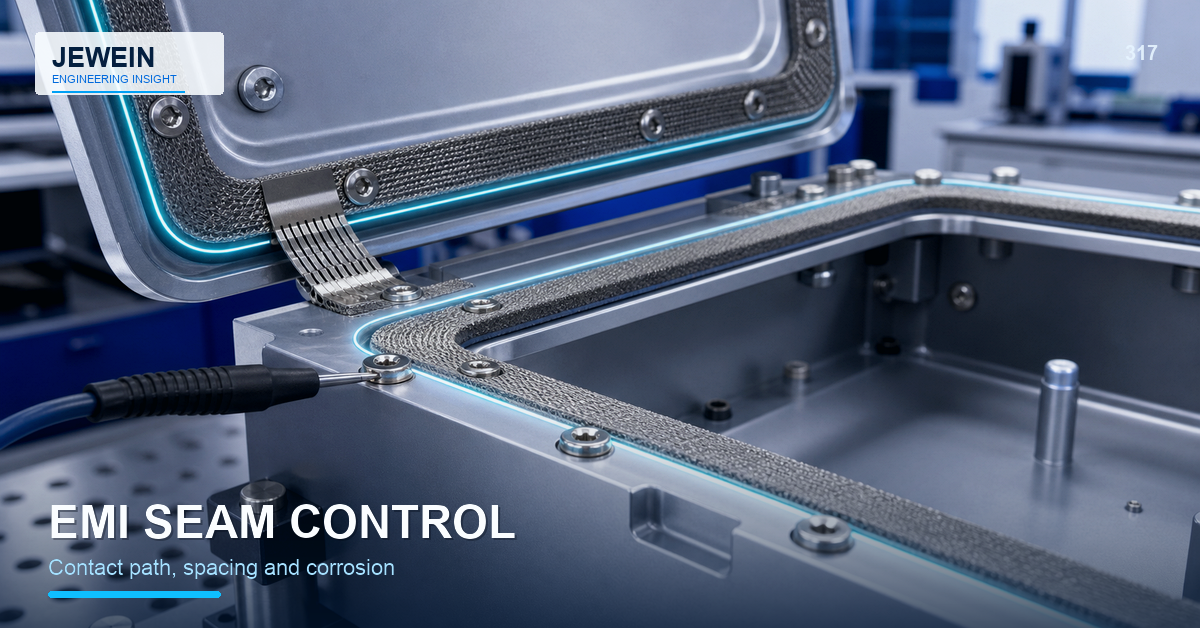
A conductive enclosure is not automatically a continuous shield. Doors, removable panels, overlapping joints, vents, cable plates, and fastener gaps interrupt the metal boundary. Paint and corrosion can turn apparent contact into an electrical discontinuity while the mechanical assembly still looks tight.
Control sheet metal enclosure EMI seams through current-path geometry, flange stiffness, contact spacing, conductive finish, gasket compression, fasteners, corrosion compatibility, testing, and service. The relevant seam is the entire path, including corners and transitions.
Map the Conductive Boundary
Trace the enclosure surface around doors, covers, panels, vents, cable entries, displays, and mounting interfaces. Mark every place where current must cross a joint.
The sheet metal grounding and bonding guide explains how conductive paths, masking, hardware pressure, corrosion, testing, and ownership work together.
Keep Contact Geometry Continuous
Long gaps, weak corners, uneven flanges, and large spacing can reduce seam continuity. The acceptable geometry depends on frequency range, field coupling, enclosure size, source location, and product requirements.
Do not copy a generic fastener pitch without system analysis. Use simulation, prior evidence, prototypes, and representative testing where the risk justifies them.
| Seam element | Electrical role | Mechanical risk |
|---|---|---|
| Bare contact land | Provides conductive path | Corrosion or contamination |
| Fastener spacing | Maintains local closure | Flange waves between screws |
| Conductive gasket | Bridges small variation | Wrong compression or aging |
| Corner transition | Continues perimeter current | Gaps from bend or weld detail |
| Removable cover | Allows service access | Damage and incorrect reassembly |
Control Paint and Surface Treatment
Ordinary powder coating can insulate a seam. Define masking, conductive coating, plating, conversion treatment, serrated hardware, or other contact strategy while protecting the surrounding metal from corrosion.
For sheet metal enclosure EMI seams, inspect the finished contact land. Masking width, overspray, edge buildup, handling damage, and repair material can change both resistance and durability.
The sheet metal powder coating masking guide helps protect threads, contacts, grounding areas, and moving fits through finishing.
Design Flanges for Stable Pressure
Thin flanges can bow between fasteners. Door twist, latch position, gasket force, and panel flatness affect contact. Add returns, beads, supports, or closer controlled contacts where necessary.
The sheet metal door alignment guide explains frame geometry, hinge axis, latch load, gasket compression, coating, and installation support.
Select Conductive Gaskets as a System
Review electrical performance, compression range, environmental seal needs, galvanic compatibility, temperature, fluids, wear, and replacement. A gasket can support both EMI and environmental functions, but the requirements may conflict.
Use the sheet metal enclosure gasket guide to coordinate flange geometry, corners, hardware, door stiffness, coating, drainage, service, and inspection.
Protect Against Galvanic and Fretting Damage
Dissimilar conductive materials, moisture, motion, and small contact areas can degrade a seam. Review plating compatibility, drainage, seal location, and service environment.
The galvanic corrosion guide helps map dissimilar metals, electrolyte paths, contact area, isolation, coatings, drainage, and inspection.
Treat Vents and Cable Entries as Boundary Features
Openings may need conductive screens, honeycomb structures, filtered feedthroughs, shielded glands, or another controlled treatment. Their mounting seam is part of the shield.
The sheet metal enclosure cable entry sealing guide connects gland fit, plate stiffness, strain relief, grounding, drainage, and service.
Verify Mechanical Assembly Before Electrical Test
Check fastener presence and torque method, panel gap, gasket seating, mask quality, contact cleanliness, and configuration. An electrical failure caused by a missing screw should not be mistaken for an enclosure material limit.
Retain setup photos and hardware configuration with the test report. Repeat after relevant service cycles when the seam is routinely opened.
Test the Complete Product Configuration
Bench resistance checks can find obvious contact problems but may not predict full shielding performance. Test with representative electronics, cables, openings, covers, and operating modes according to project requirements.
Final EMC method and acceptance require qualified specialists. Preserve failed configuration before tightening hardware or cleaning contacts, because those actions destroy useful evidence.
Control Service and Replacement
Define cleaning, gasket replacement, fastener reuse, torque, inspection, and post-service verification. Protect contact lands from paint touch-up and corrosion products.
Recheck Continuity After Repeated Access
A new door or cover may perform differently after many opening cycles. Gaskets take a set, plated contacts polish or oxidize, fasteners wear, and technicians may omit hardware. Use representative access cycles and inspect the perimeter before and after electrical testing. Retain a service checklist that identifies contact cleaning limits, replacement criteria, torque sequence, and the configuration that must be restored before power returns.
Jewein describes enclosure manufacturing and supplier coordination in its company overview. Final EMI architecture, frequency requirements, safety, and compliance testing require qualified EMC engineers.
For a focused sheet metal enclosure EMI seams review, contact Jewein with enclosure geometry, material and finish, frequency concerns, seam type, hardware, gasket, cable interfaces, environment, and current EMC evidence.
Frequently Asked Questions
Why do enclosure seams affect EMI shielding?
Openings and weak conductive contact can interrupt current paths and allow electromagnetic energy to couple through the enclosure boundary.
Does paint reduce seam conductivity?
Most ordinary coatings can insulate contact surfaces, so masking, conductive finishes, hardware, gaskets, and corrosion protection need coordinated design.
How does fastener spacing affect an EMI seam?
Spacing influences contact continuity and local gaps, but suitable values depend on frequency, stiffness, gasket behavior, geometry, and test requirements.
When is an EMI gasket needed?
Use one when the seam requires compliant conductive contact, but compression, finish, galvanic compatibility, environment, service, and replacement must be controlled.
How should EMI seam performance be verified?
Use project-appropriate bonding checks, contact inspection, enclosure or system tests, configuration control, and retesting after relevant service or design changes.