


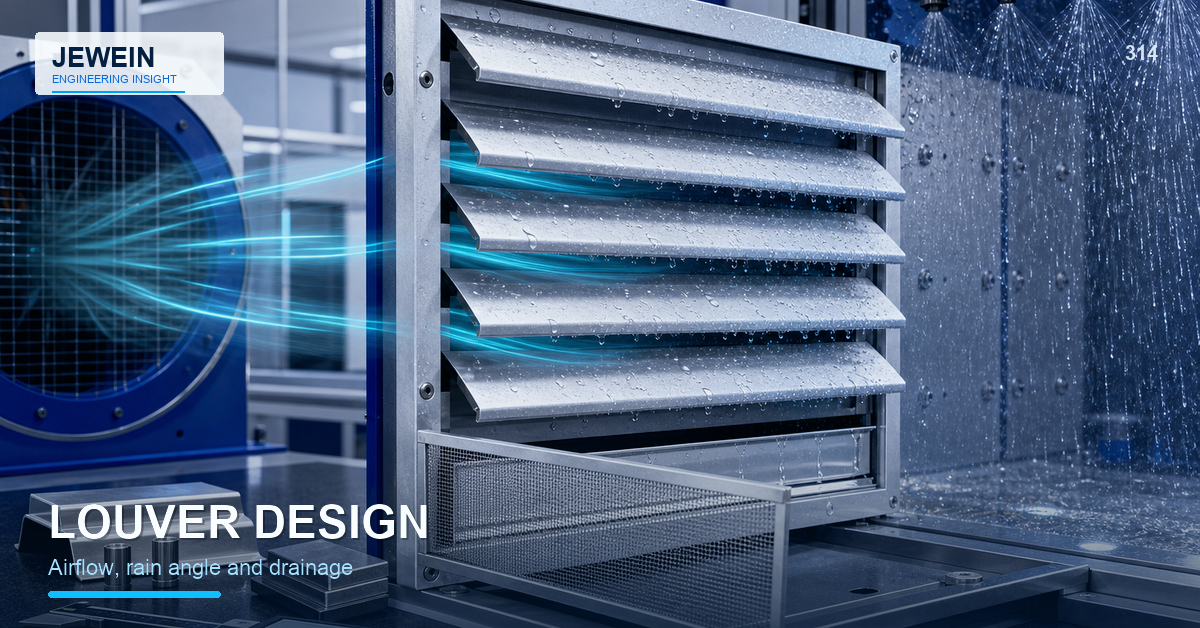
Louvers can move air through a wall without leaving a direct square opening, but the formed blades add pressure loss and create their own water paths. A louver field that looks generous in CAD may deliver limited airflow after screens, filters, nearby equipment, and rain baffles are added.
Plan sheet metal enclosure louver design around required airflow, blade geometry, free area, pressure difference, rain angle, drainage, screens, forming limits, finish, cleaning, and safety. The louver is part of an air system and an environmental boundary at the same time.
Start With the Air Path
Identify intake, exhaust, natural convection, fan direction, internal heat sources, recirculation zones, and nearby walls. Air must travel through the whole enclosure, not only through the visible opening.
The sheet metal enclosure ventilation guide explains how heat load, airflow, filters, openings, contamination, noise, and service access interact.
Calculate Real Free Area
The cut outline of the louver field is not the free area. Blade overlap, formed depth, side webs, screens, filters, guards, and manufacturing variation reduce the opening.
Use the finished formed geometry and installed accessories when estimating resistance. Confirm pressure loss or airflow on a representative panel where performance matters.
| Design variable | Airflow effect | Protection effect |
|---|---|---|
| Blade angle | Changes projected opening | Changes direct rain path |
| Blade depth | Adds flow restriction | Improves overlap potential |
| Vertical spacing | Controls open area | Influences drainage and splash |
| Screen mesh | Adds resistance | Controls insects and debris |
| Internal baffle | Redirects flow | Captures water but needs drainage |
Design Against Rain Direction
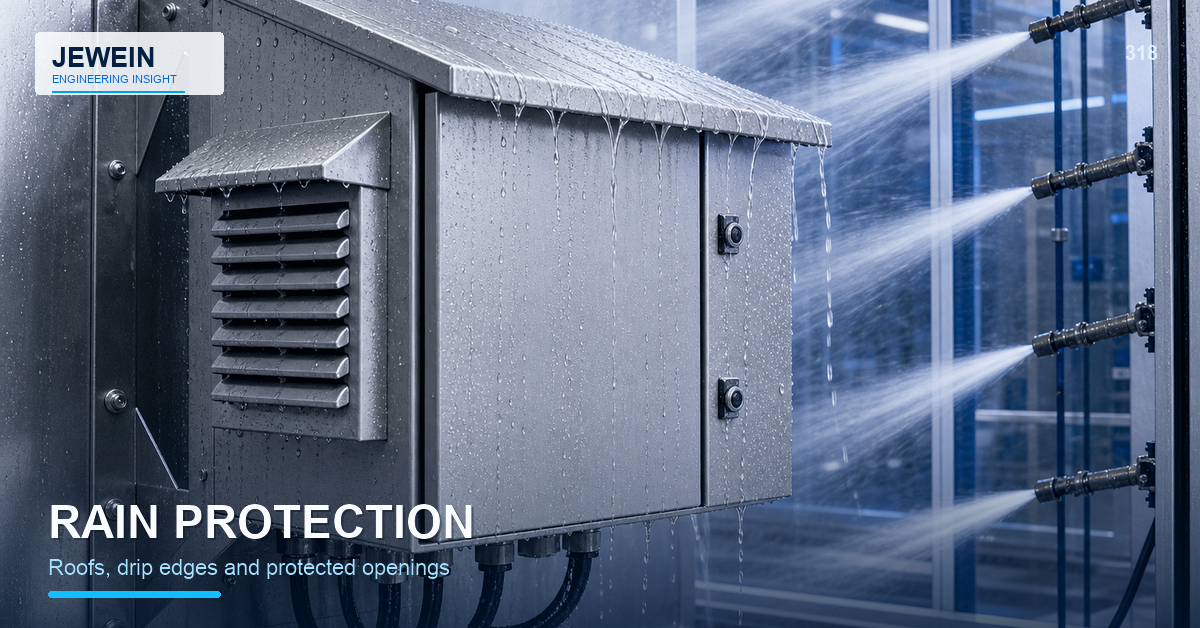
Vertical rain, wind-driven rain, splash, and hose exposure reach the blades at different angles. Orient openings away from prevailing exposure where possible and prevent water from landing on internal electronics.
For sheet metal enclosure louver design, include drainage below the field and behind any baffle. Water caught successfully by a screen or shield still needs a safe exit.
The outdoor enclosure rain protection guide covers roof runoff, drip edges, doors, vents, cable entries, and wind effects.
Coordinate Screens and Filters
Screens can reduce insect entry; filters can reduce dust. Both increase resistance and collect contamination. Decide how they are retained, sealed against bypass, removed, cleaned, and replaced.
Avoid sharp screen edges and loose mesh that can contact wiring or the fan. Use compatible materials and finishes in wet environments.
Check Forming Capability and Panel Distortion
Louver size, spacing, orientation, material, thickness, tooling, edge distance, and field density affect forming. Dense louver arrays can bow or twist a panel.
The sheet metal bend relief guide provides context for managing formed-feature interaction near bends and edges. Keep sufficient margins for tooling and panel stiffness.
Manage Finish and Cut Edges
Powder coating can bridge narrow gaps, build on edges, and change free area. Pretreatment liquid can become trapped behind blades. Brushed sheet can show local grain distortion from forming.
Use the sheet metal finish callout guide to define coverage, masking, color, texture, inspection, packaging, and revision ownership.
Protect Hands and Cables
Blade edges and punched openings can create hand or cable hazards. Define deburring, edge direction, guards, minimum access, and internal clearance.
Do not assume the outer blade hides every sharp edge. Inspect both faces after forming and finishing.
Avoid Short-Circuit Airflow
If intake and exhaust louvers are too close, air can bypass hot components. Internal partitions, ducts, fan placement, and component spacing may be necessary.
Test with the actual internal layout. An empty enclosure airflow result can overstate cooling after production wiring and modules restrict the path.
Verify Environmental and Thermal Performance
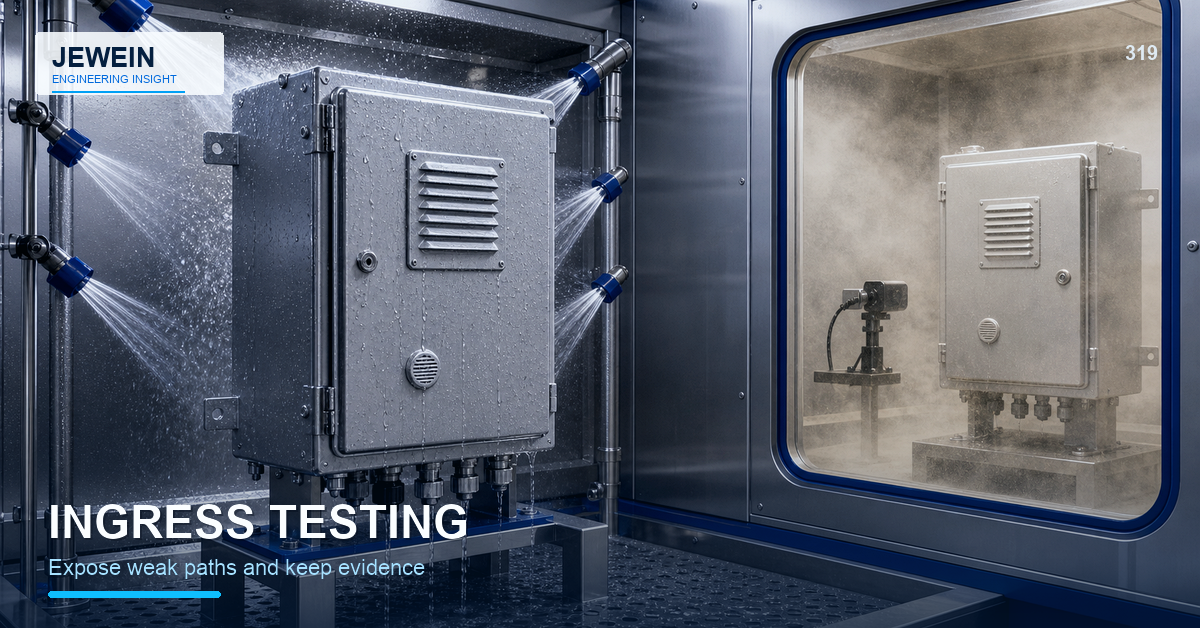
Measure temperature and airflow under representative heat load, filter condition, orientation, and ambient exposure. Test rain or ingress with production screens, seals, finish, and drainage.
The sheet metal enclosure ingress testing guide helps connect setup, exposure, weak paths, and failure evidence.
Plan Cleaning and Replacement
Provide access without removing unrelated equipment. Define cleaning direction so debris is not pushed inside. Protect thin blades from service damage and keep replacement screens traceable.
Check Noise, Ice, and Outdoor Obstruction
High air velocity can create tonal noise at blades or screens. In cold climates, captured water can freeze across openings or distort thin louver edges. Leaves, snow, packaging, and nearby walls can also reduce free area after installation. Review these conditions separately from the clean laboratory airflow test, and define inspection or clearance rules that field technicians can follow without special instruments.
Jewein describes enclosure manufacturing and DFM review in its company overview. Final thermal performance, opening safety, and environmental qualification require qualified product specialists.
For a focused sheet metal enclosure louver design review, contact Jewein with heat load, airflow target, fan data, material and thickness, louver geometry, screen or filter, exposure, orientation, and current test results.
Frequently Asked Questions
How do louvers affect enclosure airflow?
Free area, blade angle, depth, spacing, screens, filters, pressure difference, and nearby obstructions all influence actual flow.
Can louvers keep out wind-driven rain?
They can reduce direct entry, but orientation, overlap, wind angle, droplet size, drainage, internal baffles, and test conditions determine performance.
Should enclosure louvers include screens?
Screens may control insects or debris, but they add resistance, collect dirt, complicate finish, and need cleaning access.
Can large louver fields weaken a panel?
Yes. Forming removes flat stiffness and can distort the panel, so margins, ribs, frame support, tooling, and handling need review.
How should louver performance be verified?
Measure airflow or pressure loss as needed, inspect formed geometry and finish, and test representative rain, drainage, safety, and cleaning conditions.