



Inspecting five parts means little if nobody can explain which five, from what lot, and what happens when one fails. A useful sampling plan connects product risk with process history, sample selection, acceptance, containment, and traceability. It is a decision system, not merely a sample count.
Build a sheet metal inspection sampling plan around a clearly defined lot and characteristics that matter to fit, safety, sealing, appearance, and service. Increase control when evidence weakens, and reduce it only through an agreed rule supported by stable process data.
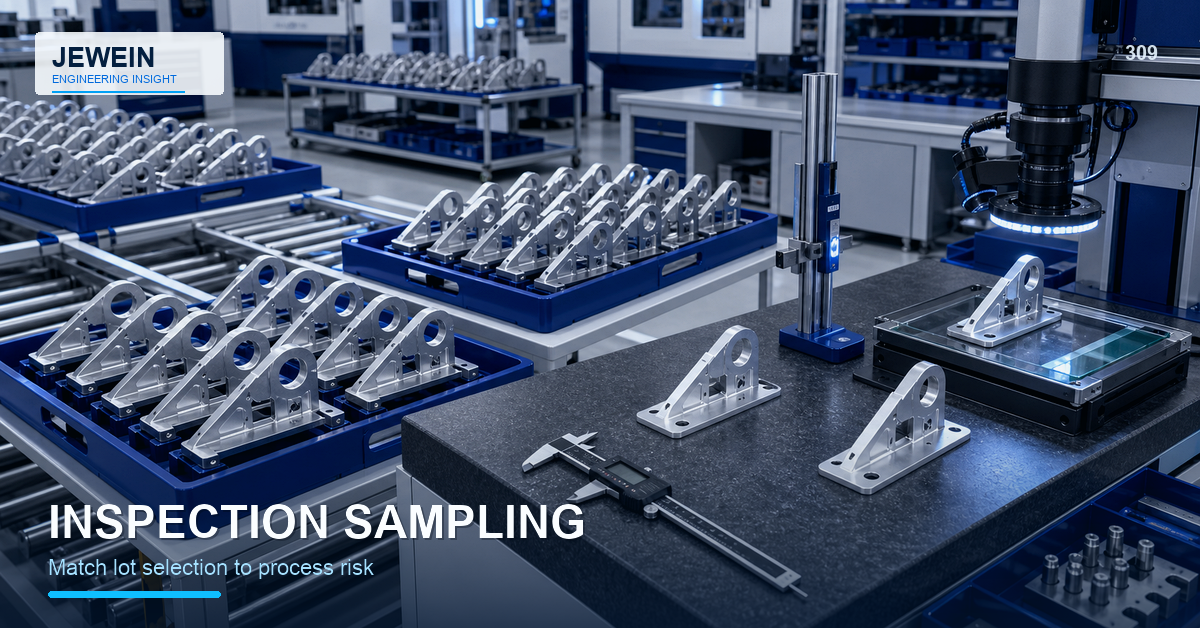
Define the Lot Before the Sample
A lot might represent one material heat, coil, work order, cutting nest group, press-brake setup, weld fixture run, coating rack, shift, or shipment. If the lot mixes meaningful process conditions, a small sample can miss entire subgroups.
The sheet metal part marking guide explains how identity must survive finish and handling. Link samples to the production records needed for containment.
Classify Characteristics by Consequence
Separate safety or regulatory features, assembly-critical dimensions, sealing surfaces, hardware retention, cosmetic criteria, and routine dimensions. Their control intensity does not need to be identical.
The sheet metal inspection checklist provides a broad map of material, cutting, bends, welds, hardware, finish, cleanliness, labels, packaging, and assembly interfaces.
| Characteristic group | Example | Sampling direction |
|---|---|---|
| Critical function | Grounding contact or retained hardware | Strong control and explicit reaction |
| Assembly fit | Hole pattern or flange location | Risk and capability based |
| Process indicator | Bend angle or coating thickness | Trend across time or setup |
| Cosmetic | Scratch, color, texture | Defined viewing standard and spread |
| Packaging | Protection and labels | Shipment or pack-level coverage |
Spread Selection Across the Process
Convenience samples from the top of one box can hide time and location effects. Select across the beginning, middle, and end of a run when appropriate. Consider nests, tools, operators, shifts, weld stations, coating racks, and package positions.
For a sheet metal inspection sampling plan, state who selects samples and whether selection is random, systematic, stratified, or event based. Protect against substitution after results are known.
The sheet metal nesting guide gives context for how part position, heat, common lines, and material use can create location-specific risk.
Match Frequency to Process Evidence
A new setup, transferred supplier, repaired tool, revised program, or unstable process deserves more evidence than a mature controlled route. Define triggers for tightened inspection and conditions for returning to normal frequency.
Do not reduce checks simply because recent lots passed. Use process history, maintenance, capability evidence, complaint history, and change control. The process capability review guide helps distinguish one acceptable sample from repeatable production.
State the Acceptance Rule
The plan should say what constitutes a defect, how many are permitted, whether different defect classes are combined, and how borderline results are handled. Visual characteristics need references for lighting, distance, angle, and viewing time where relevant.
Avoid vague instructions such as "inspect randomly" or "check as needed." The production team needs an executable rule, and the customer needs to know what evidence the rule provides.
Define the Failure Reaction Before Failure
When a sample fails, determine lot status, containment boundary, expanded inspection, rework or scrap authority, root-cause review, corrective action, and customer notification requirements.
Preserve failed parts and as-found data before sorting erases the pattern. Check whether the defect is isolated, time related, tool related, or present across the lot.
Use Variable Data Where It Adds Value
Pass/fail checks are efficient, but variable measurements can reveal drift before parts cross the limit. Use them for features where trend and process adjustment matter.
Do not collect numbers without a reaction plan. A spreadsheet full of measurements is not process control when nobody reviews sequence, subgroup, or change signals.
Keep Measurement Capability in Scope
Sampling cannot compensate for a weak inspection method. Verify fixture repeatability, instrument resolution, visual standards, appraiser training, and uncertainty for the characteristic.
The first article inspection guide helps connect early sample approval with the evidence needed before routine sampling begins.
Retain Traceable Records
Record lot identity, sample identity, production position or time, drawing revision, characteristic, method, result, inspector, equipment, disposition, and reaction. Use consistent defect codes so patterns can be found later.
Review sampling effectiveness after complaints, escapes, excessive sorting, or process improvements. A plan should evolve through controlled revision, not undocumented shop habits.
Jewein outlines manufacturing-risk and supplier review in its company overview. Final sample sizes, acceptance criteria, and regulatory obligations require qualified quality specialists and customer agreement.
For a focused sheet metal inspection sampling plan review, contact Jewein with annual volume, lot structure, critical features, process route, capability history, defect consequences, current inspection records, and required customer format.
Frequently Asked Questions
What should a sheet metal sampling plan define?
It should define the lot, characteristics, selection method, sample size or frequency, acceptance rule, escalation, records, and responsible owner.
Why should samples be selected across the lot?
Spread selection can reveal time, nest, tool, shift, rack, and handling variation that a convenient top-of-box sample may miss.
Should critical features use the same sampling as cosmetic features?
Not automatically. Consequence, process capability, detection method, customer requirements, and traceability should influence control intensity.
When should inspection frequency increase?
Increase it after process changes, maintenance, supplier transfer, instability, nonconformance, weak capability evidence, or other defined risk signals.
What happens when a sample fails?
Use a predefined reaction covering containment, lot status, expanded checks, root-cause review, disposition, corrective action, and customer communication when required.