


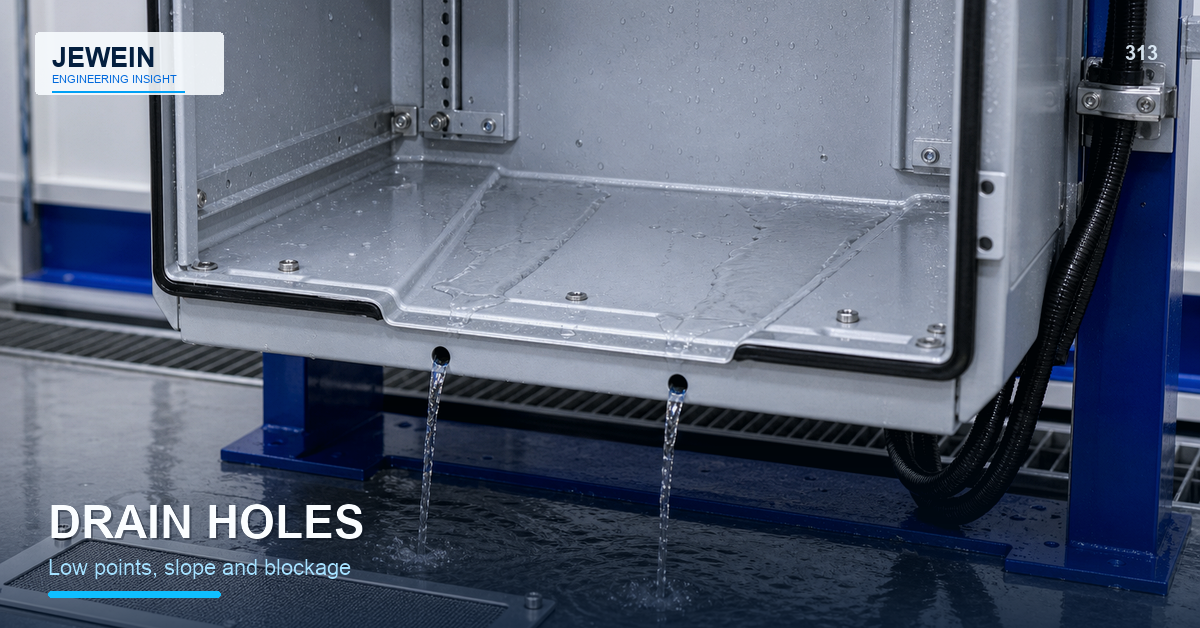
An enclosure can include good gaskets and still collect water from condensation, service, cable tracking, or a rare ingress event. If the water reaches a channel with no outlet, a small amount can remain against cut edges and hardware for a long time. Drainage must follow the installed orientation, not the convenient bottom of the CAD model.
Design sheet metal enclosure drain holes around real low points, slope, water volume, opening risk, debris, insects, splash, corrosion, and cleaning. A drain is an intentional boundary opening, so its exit path needs the same care as its inlet path.
Identify Every Water Source
Map condensation, roof runoff, door opening, washdown residue, cable tracking, fan-filter leakage, and internal pipe or component failure when relevant. Different sources reach different collection zones.
The sheet metal enclosure condensation guide explains why internally generated water may appear far from an external leak.
Use the Installed Orientation
Check wall mounting, floor slope, leveling feet, pole brackets, transport orientation, and field tolerances. A nominally horizontal base may not stay horizontal outdoors.
Build channels and low points that remain effective within expected installation variation. Avoid closed hems, overlapping seams, and hardware pockets that trap water before it reaches the drain.
| Drainage question | Failure if ignored | Verification |
|---|---|---|
| True low point | Water remains in another corner | Installed-orientation water test |
| Continuous slope | Puddles form behind beads or folds | Section and flow observation |
| Opening size | Surface tension or debris blocks flow | Representative contamination test |
| Discharge zone | Water reaches cables or wall | External runoff inspection |
| Screen condition | Mesh clogs or corrodes | Aged and dirty check |
Size for Water and Debris
Small holes can resist flow because of surface tension, paint buildup, burrs, mesh, or contamination. Large openings may weaken environmental protection or allow insects and tools to enter.
For sheet metal enclosure drain holes, validate the finished geometry after coating, not only the laser-cut diameter. Define whether edges are deburred, masked, plugged during finish, or fitted with a drain component.
Prevent Backflow and Direct Splash
Place drains away from tire spray, hose impact, puddles, roof runoff, and upward wind-driven rain. Use shields, downward-facing geometry, tubes, labyrinth paths, or internal baffles when the environment requires them.
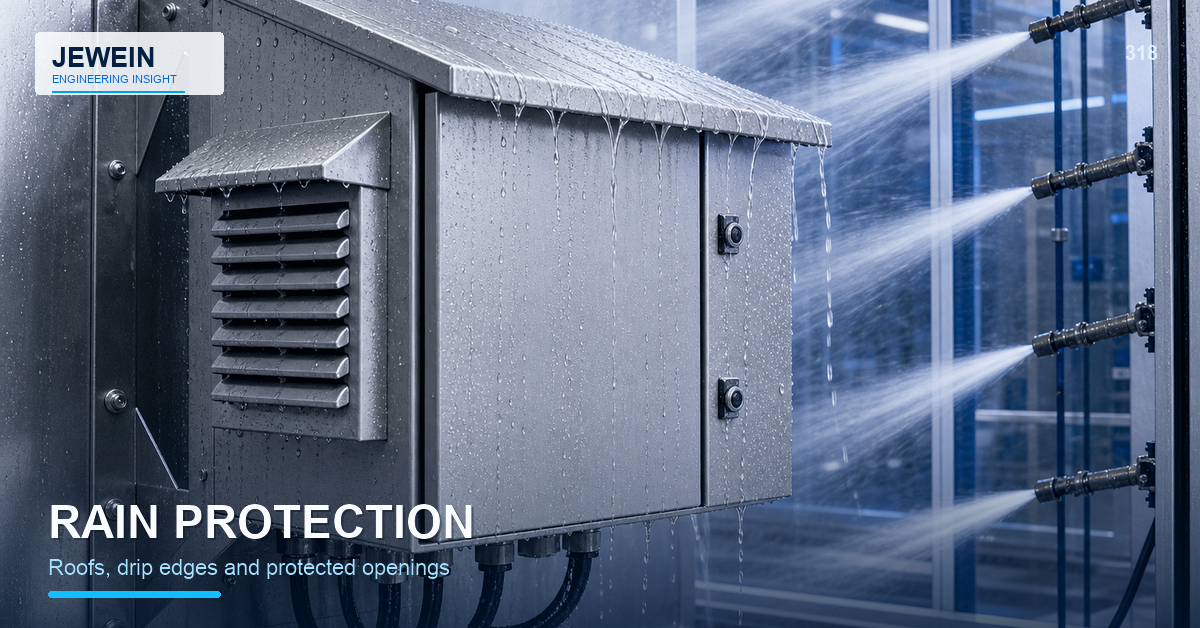
The outdoor enclosure rain protection guide connects drains with roof slope, drip edges, doors, vents, and cable entries.
Coordinate Screens and Insect Control
Mesh can keep out insects or debris but reduces open area and can hold dirt or water. Select material for corrosion compatibility and make cleaning possible.
Do not bury a screen where replacement requires disassembling energized equipment. Record mesh identity and attachment so unapproved substitutes do not change drainage.
Protect Cut Edges and Nearby Hardware
Drain zones stay wet longer than other surfaces. Review coating coverage, conversion treatment, stainless or plated hardware, weld cleanup, and galvanic contact.
The galvanic corrosion guide helps map dissimilar metals, electrolyte paths, contact area, isolation, and drainage. Avoid creating a drain that directs water across a vulnerable joint.
Keep Internal Components Out of the Path
Wires, labels, insulation, mounting plates, foam, and loose hardware can block the hole. Maintain clearance and add drip shields where components cannot move.
Route condensate away from terminals and cable loops. A drain should not require water to cross the most sensitive zone before leaving.
Design for Cleaning and Inspection
Technicians need to see or probe the drain without damaging seals. Define inspection points, acceptable blockage, cleaning tools, and post-service checks.
The sheet metal enclosure gasket guide provides context for keeping service work from damaging the main door boundary while accessing low points.
Test the Full Drainage Path
Use representative water volume, orientation, coating, screens, internal hardware, and external exposure. Observe where water first collects, how quickly it exits, and whether any remains after the test.
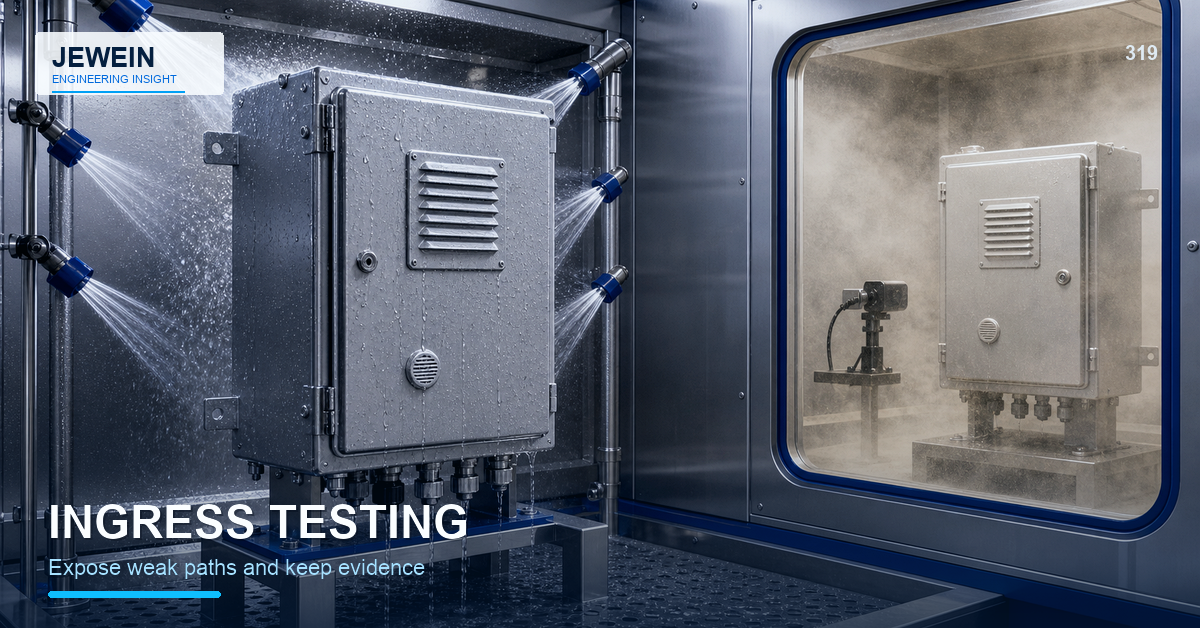
The sheet metal enclosure ingress testing guide helps preserve weak-path evidence before teardown. Passing drainage does not automatically prove the enclosure resists the required external exposure.
Allow for Installation Tolerance
Field brackets, uneven walls, floor slope, pole rotation, and leveling feet can move the practical low point. Test the drainage path at the allowed installation extremes instead of one carefully leveled sample. If the design depends on a precise tilt, make that tilt measurable during installation and visible during service. A drain that works only in the nominal CAD orientation is difficult to defend in production.
Jewein describes enclosure DFM and manufacturing-risk coordination in its company overview. Final opening size, environmental protection, and test acceptance require qualified design and test specialists.
For a focused sheet metal enclosure drain holes review, contact Jewein with enclosure orientation, water sources, required protection, coating, screen needs, component layout, low-point photos, and current drainage results.
Frequently Asked Questions
Do drain holes reduce enclosure protection?
They create intentional openings, so location, geometry, baffles, screens, exposure, and the required protection level must be evaluated together.
Where should enclosure drain holes be placed?
Place them at true installed low points with a continuous path from internal collection zones and without discharging onto sensitive equipment.
How large should a drain hole be?
Size depends on expected water volume, debris, surface tension, manufacturing tolerance, screens, cleaning, and the accepted opening risk.
Should drain holes use insect screens?
Screens may be needed, but mesh can reduce drainage, retain debris, corrode, or clog, so the full assembly needs validation.
How should enclosure drainage be inspected?
Check orientation, slope, blockage, burrs, coating, screens, internal obstructions, discharge path, and a representative water-flow test.