


Peeling often appears first at assembly, when a screw head twists against the film or a cover flexes into place. The same panel may have looked flawless beside the oven. By the time the defect is found, it is tempting to blame the powder, increase cure, and move on.
A useful powder coating adhesion investigation begins at the exposed interface instead. Work backward from the failed surface through handling, cure, film build, pretreatment, rinsing, cleaning, and the incoming metal before changing several variables at once.
Start at the Failure Surface
Look at both sides of the separation. Is bare metal visible, is a pretreatment layer attached to the film, did the film fracture internally, or has corrosion lifted it from below? Photograph the interface before anyone cleans it, and keep the failed piece with its mating hardware.
This first observation does not always prove cause, but it prevents an assembly chip from being investigated as if it were a line-wide chemical failure. Difficult cases may still need laboratory analysis.
Trace the Part Back to Incoming Metal
Mill oil, laser residue, punching lubricant, rust inhibitor, fingerprints, oxide, welding smoke, grinding dust, silicone, and adhesive can interfere with preparation. Mixed metal grades or substituted stock may respond differently.
Record the actual material lot and fabrication route. A clean test panel processed beside dirty production parts does not prove that the wash system handles the production soil load.
Audit Pretreatment as a Complete Sequence
Follow one production part through the washer. Watch spray access behind flanges, how the enclosure drains, where rinse water remains, and how long the part waits before powder. A control coupon hanging in open space may not experience the same cleaning or dry-off.
The aluminum conversion coating guide shows how functional zones, drainage, and paint compatibility should be reviewed on aluminum parts. Similar geometry questions apply to other pretreatment routes.
Separate Film Build From Cure
Thickness affects heat response and mechanical behavior, but it is not a cure measurement. Part-metal temperature and time matter more than oven air indication alone.
For powder coating adhesion, review the real oven profile for the part mass, hanging arrangement, line loading, and coldest critical zone. A thin panel and a heavy welded bracket on the same rack may not reach the same history.
The powder coating thickness guide helps connect film build to edge coverage and assembly fit.
Check Geometry and Handling Damage
Sharp edges, tight bends, laser oxide, weld spatter, deep recesses, and flexible panels can create local weakness. Driver slips, hooks, bins, fasteners, and forced assembly can damage an otherwise acceptable finish.
Inspect whether failure begins at an impact, cut edge, bend, masked transition, thread, or contact point. The root cause may be mechanical rather than chemical.
Select a Test That Matches the Question
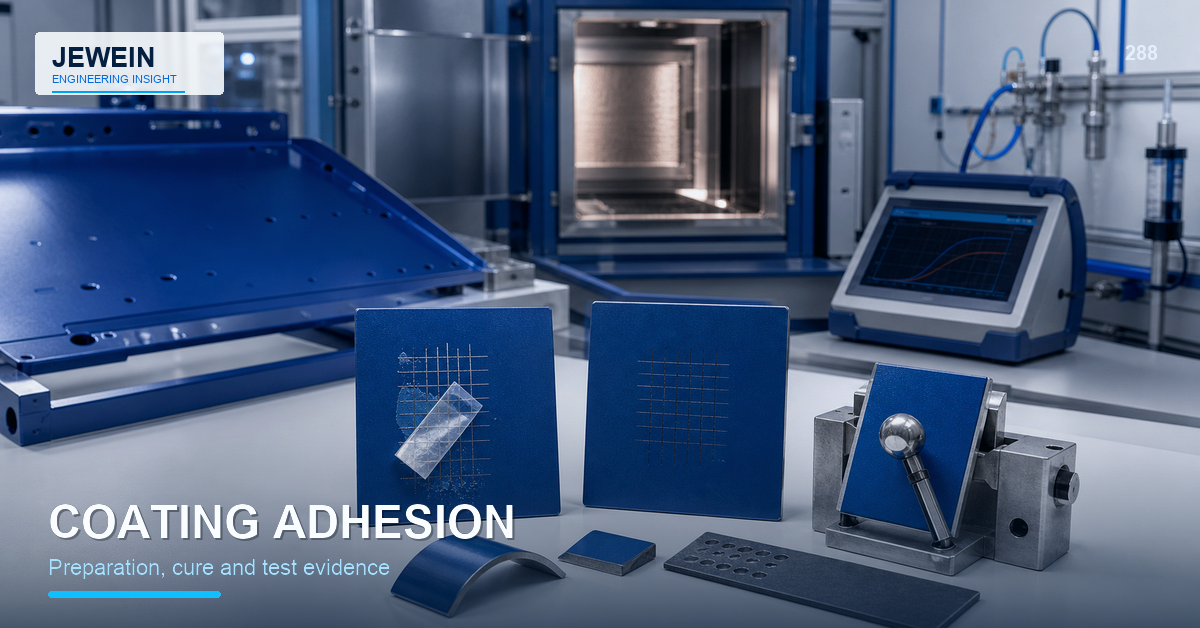
Cross-cut, bend, impact, pull-off, and other methods stress the coating differently. Select the method because it represents the governing requirement or failure question, not because it is the easiest tool on the bench.
| Question | Evidence direction |
|---|---|
| Is the process stable on flat production material? | Controlled coupon test plus process records |
| Does the finish survive a formed edge? | Representative formed sample and edge inspection |
| Will assembly damage the film? | Mating-part and torque trial |
| Is field peeling linked to moisture? | Failure analysis plus corrosion and adhesion evidence |
When a flat coupon passes but a formed edge fails, keep both results. The difference is evidence about geometry or handling, not permission to discard the inconvenient test. Document any method change before retesting.
Keep a Known Control Panel
Process a documented control panel with production loads at a defined frequency. Store accepted controls cleanly and track material, pretreatment, powder, cure, and test results. When a field or assembly failure appears, a control from the same production window helps separate a broad line problem from local geometry, handling, or contamination on the affected part.
Contain the Lot Before Repairing It
When failure is found, identify affected finish batch, material lot, line window, rack, oven load, and production shift. Hold related parts until the extent is understood.
Local touch-up may hide evidence and is not a root-cause correction. The sheet metal coating repair guide provides a decision framework for limited damage and documented rework.
Build a Reaction Plan by Failure Mode
Match the response to what the evidence shows. Oil on the failure surface points toward cleaning and soil loading. A cold heavy section beside acceptable thin panels points toward the oven profile. Damage centered beneath a driver path calls for tool-access or assembly changes.
Only then decide whether stripping and recoating is allowed. State how the substrate is restored, how many cycles are acceptable, and what reinspection follows. Repeated heating can affect dimensions, inserts, sealants, and material condition.
Retain Evidence From Process to Shipment
Keep the evidence in one timeline: material lot, fabrication soil, washer records, rinse and dry status, powder lot, film readings, oven profile, test result, assembly observation, nonconformance, and disposition. A complete timeline is more useful than separate logs that cannot be tied to the failed panel.
Jewein describes its manufacturing feasibility and quality approach in the company overview. Final test methods and acceptance criteria need the approved coating specification and qualified finishing expertise.
For a focused powder coating adhesion review, contact Jewein with the substrate, fabrication route, pretreatment, powder system, thickness data, oven profile, failure location, test method, photographs, and affected lot history.
Frequently Asked Questions
Why can a good-looking powder finish peel?
Appearance may hide contamination, poor pretreatment, rinse residue, undercure, substrate mismatch, local damage, or corrosion beneath the film.
Does a thicker film bond better?
Not automatically. Excess build can cure unevenly, bridge geometry, chip, retain defects, or mask weak substrate preparation.
Which adhesion test should be used?
Choose the method required by the governing specification and suited to the substrate, coating, thickness, geometry, and service question.
Can undercured parts simply be baked again?
Only through an approved disposition. Reheating may not correct every failure and can affect color, gloss, dimensions, hardware, or material condition.
What should happen after an adhesion failure?
Contain the related lot, preserve samples, identify the failure interface, review process records, correct the cause, and requalify before release.